
2025-26 performance highlights
Shift public sector culture highlights
Enforcement highlights
The issuing of the first certificate of debt (CoD) marked a defining moment for our material irregularities process, which is our expanded mandate. This CoD holds a municipal manager accountable for overpayments of R4,6 million for water tankering services.

Sustainably highlights
Efficiently highlights

Shifting public sector culture:
Driving accountability and incrementable improvements
Performance against 2025-26 targets
| Key performance indicator | 2025-26 target | Year-end actual | Status |
|---|---|---|---|
| Favourable assessment | Favourable assessment | Favourable assessment | |
| Implementation of the culture shift programme across each category of our auditee base | Implementation of programmes in identified value chains, metropolitan municipalities and disclaimer auditees 1. Metros 2. Key public entities 3. Disclaimer auditees 4. Coordinating institutions 5. Yellow zone auditees (Unqualified with findings on compliance and/or predetermined objectives) | Implemented per the implementation plan initiatives |
Shifting public sector culture remains a longterm structural reform priority, focused on strengthening accountability, transparency, institutional integrity and audit outcomes, ultimately contributing to improved service delivery and enhanced quality of life for citizens.
During the 2025–26 financial year, the institution implemented its #cultureshift2030 programme across auditee segments including metropolitan municipalities, key public entities, disclaimer auditees, coordinating institutions and auditees with unqualified audit opinions accompanied by findings (yellow zone). Implementation progressed in alignment with approved plans.
While progress towards sustained high performance remains below the desired ambition, the year under review demonstrates early signs of traction, characterised by:
- Containment of regressions in audit outcomes
- Emerging areas of improvement within targeted environments
- Strengthened leadership engagement, consequence management, and coordinated interventions.
Status of auditees on the cultureshift continuum
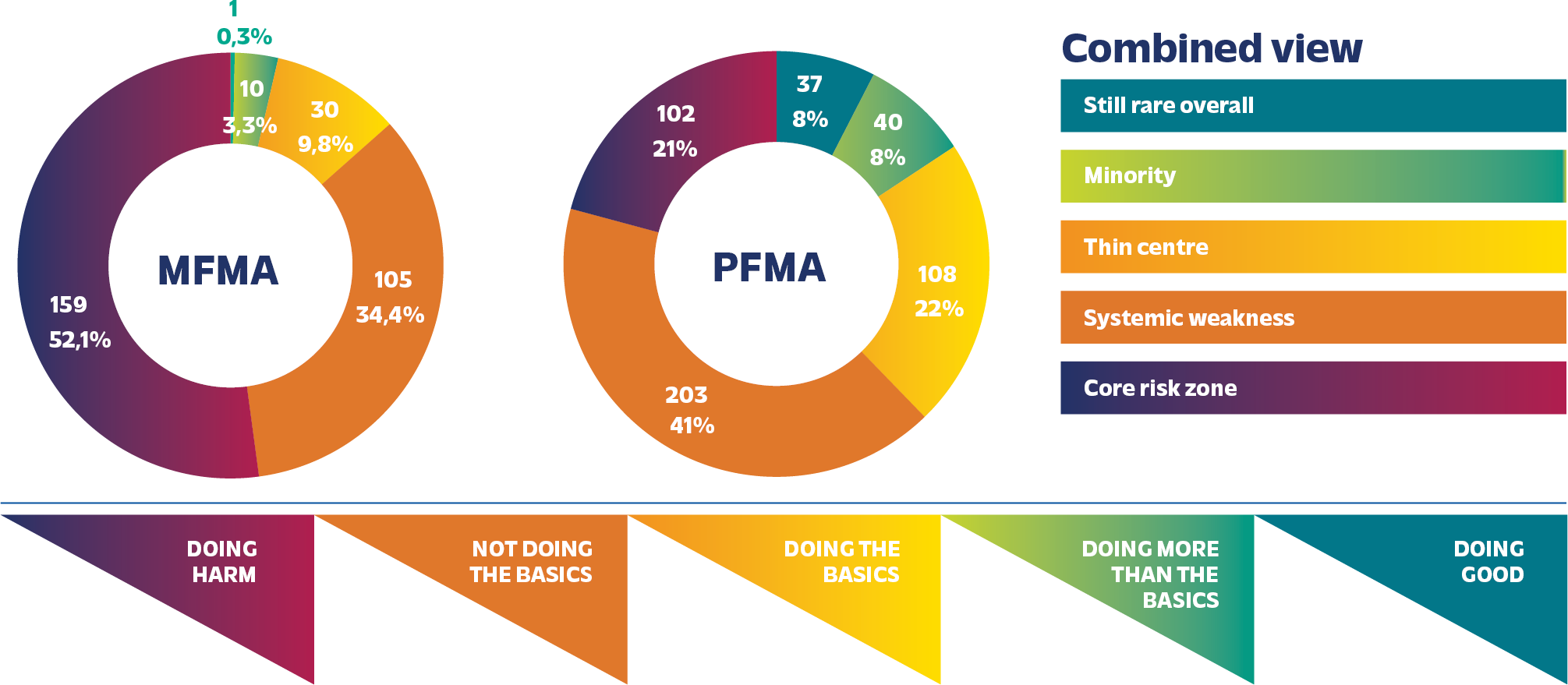
Across both the PFMA and MFMA environments, the proportion of auditees doing good remains limited, indicating constrained levels of systemic maturity. A significant share of auditees continues to fall within the ‘not doing the basics’ and doing harm’ categories, reflecting deeply entrenched governance weaknesses. This systemwide profile underscores persistent structural risk and will be a continued focus for the organisation as it continues to enable auditees to move in the right direction on the continuum.
Incremental shifts: reduction in disclaimers
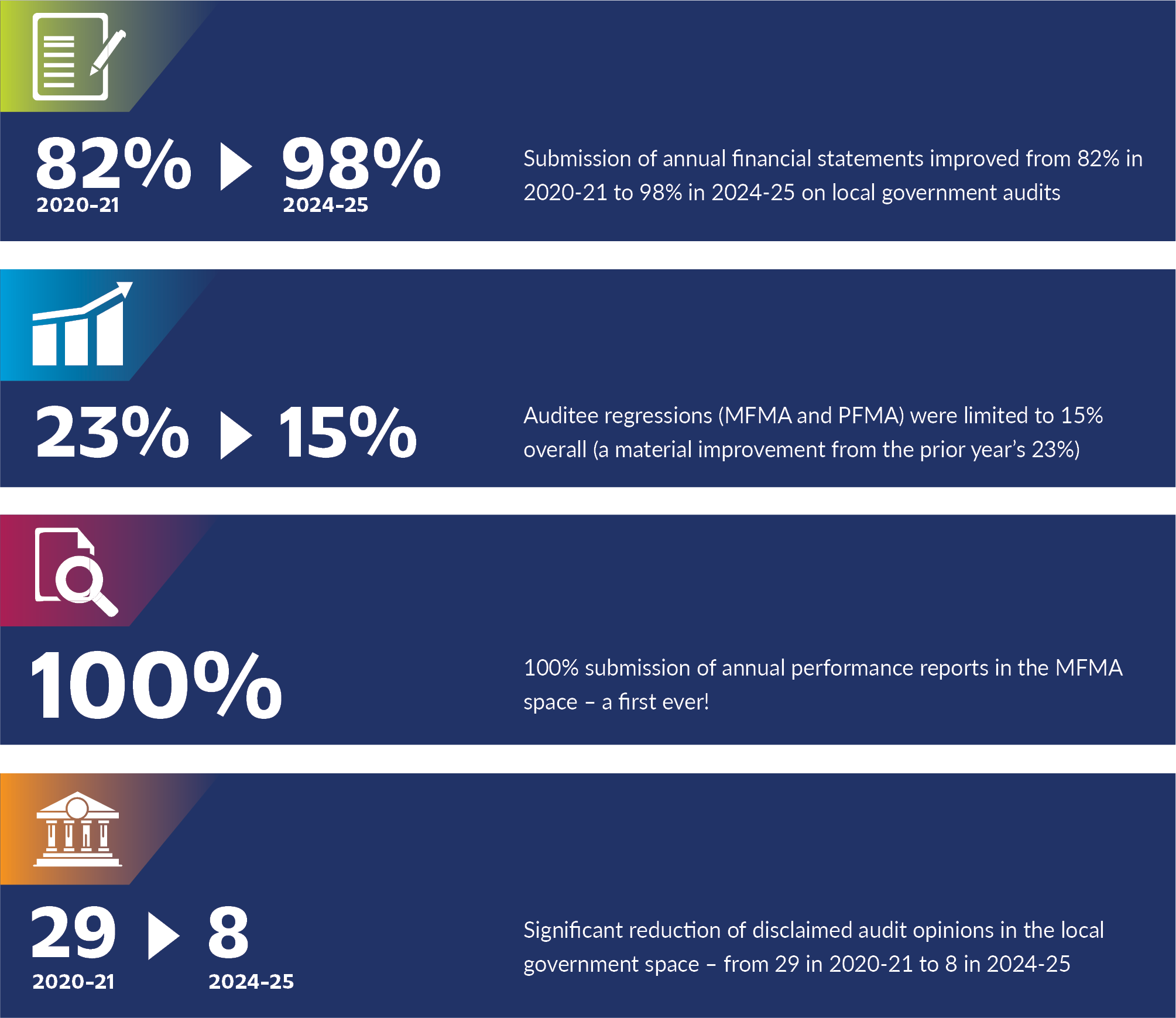
A notable indicator of progress for the shift public sector culture programme is the sustained reduction in disclaimer audit outcomes, particularly in local government. The 29 disclaimers at the start of the administration had dropped to 15 in the previous year and to eight in the review year. This reflects strengthened financial reporting disciplines, increased in-house preparation of financial statements by auditees and enhanced ownership and accountability in management core outcomes envisaged by the #cultureshift2030 strategy.
These incremental gains further signal early behavioural shifts, with accountability increasingly being internalised rather than outsourced. This is a crucial enabler and foundational step to achieving sustainable governance reform in local government.
Strengthening accountability through implementation of recommendations
At high-impact auditees, 49% of recommendations have either progressed to implementation or are on track. This has contributed to measurable improvements in governance, reporting credibility and service delivery outcomes. However, systemic challenges persist, including:
- Weak follow-through on corrective actions
- Slippage against planned implementation timelines
- Inconsistent activation of consequence management.
While responsiveness to recommendations is improving, its translation into sustained enhancements in audit outcomes remains limited. This points to a persistent gap between stated commitment and effective execution of commitments.
Strengthening financial reporting disciplines
Local government submission discipline for annual financial statements improved significantly. This reflects stronger accountability signals, driven partly by enforcement mechanisms such as the material irregularities process. In addition, submission of performance reports reached 100% for the first time in MFMA audits. Improvements in recordkeeping, interim reporting and internal audit practices further contributed to enhanced reporting credibility in selected environments.
Persistent risk: congestion in the yellow zone
Despite encouraging progress, numerous auditees remain in the unqualified with findings category. This category is characterised by basic-level compliance, with underlying governance, performance management and accountability frameworks remaining weak.
This yellow zone reflects systemic stagnation, where institutions demonstrate stability without substantive improvement, thereby posing an inherent risk of regression. Audit evidence consistently identifies four primary drivers underpinning this stagnation:
- Execution failures, particularly in supply chain management and operational delivery
- Weak or delayed consequence management
- Instability in leadership positions
- Persistent adjustments to annual financial statements and predetermined objectives.
Where these constraints have been directly addressed, auditees have demonstrated measurable upward movement in areas such as submission of financial statements and responsiveness to our recommendations, confirming that leadership discipline and execution capability are important levers for change. Accordingly, the audit office will continue to advocate these disciplines and capabilities through its audit insights and influence initiatives, thereby contributing to the progression of yellow zone auditees towards higher levels of performance on the #cultureshift2030 continuum.
Audit outcomes of high-impact sectors
As evidenced by the Pati analysis of high-impact sectors outlined below, challenges persist within some of the country’s most crucial sectors.
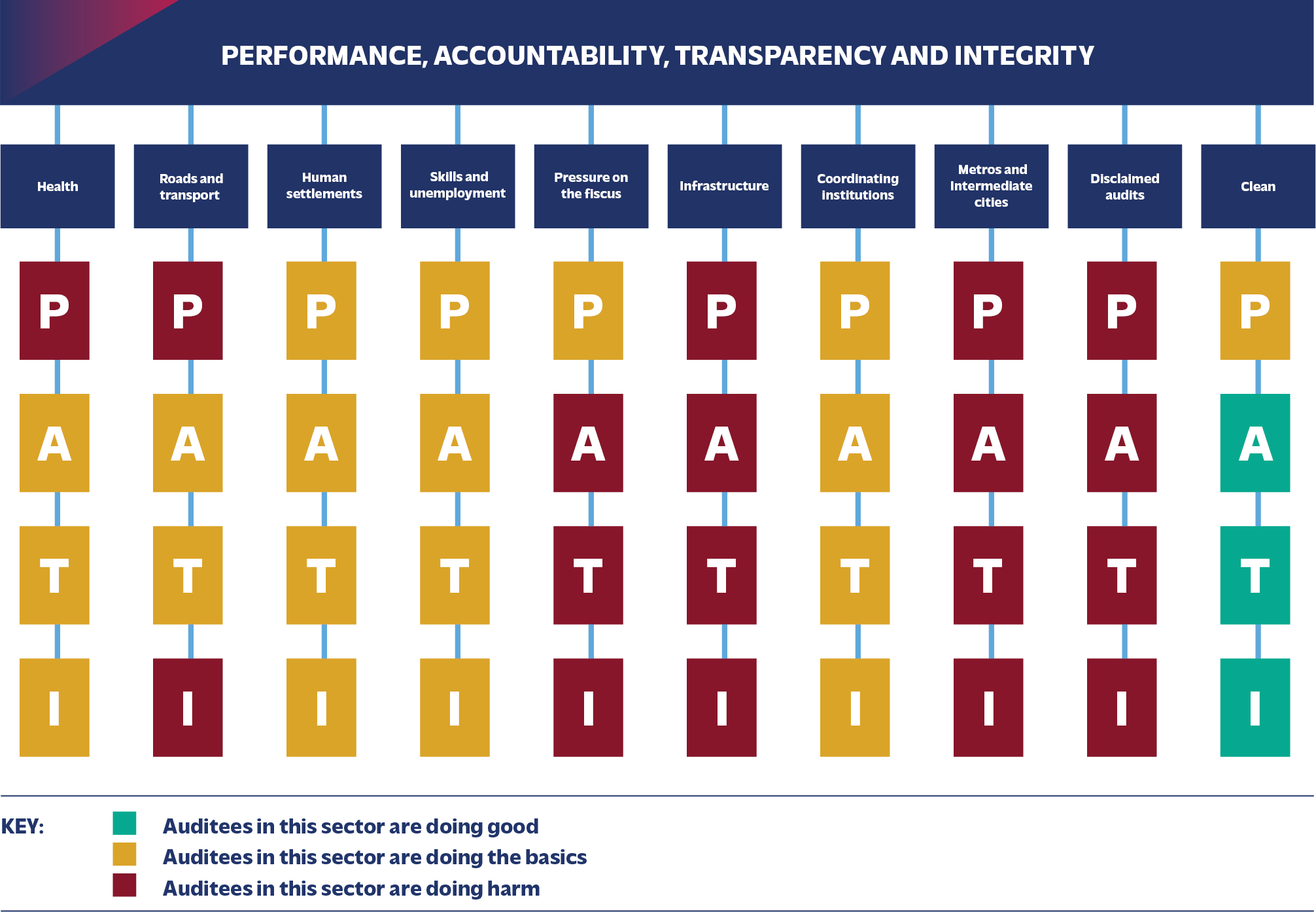
Health
The health sector exhibits more severe and multidimensional failure patterns. Here, the most frequently failed criteria include supply chain management compliance, financial statements credibility and consequence management.
The scale and complexity of procurement for medical supplies, infrastructure maintenance and outsourced services significantly elevate compliance risk, leading to irregular expenditure and recurring material findings. These weaknesses are often compounded by delays or failures in investigating irregularities and enforcing accountability. The sector contributes disproportionately to not doing the basics and doing harm classifications, despite being among the most financially significant and service critical sectors in government.
Human settlements
Particularly provincially, under the PFMA, and through associated housing entities and municipal housing functions under the MFMA, failures are strongly concentrated around supply chain compliance, infrastructure project failures or delays and consequence management.
Human settlements programmes are typically infrastructure intensive and grant funded, creating high exposure to procurement irregularities, cost overruns, incomplete projects and weak contractor oversight. While financial statements are often auditable, pervasive supply chain weaknesses and poor oversight of housing projects prevent the sector from progressing beyond doing the basics.
Weak or delayed consequence management allows repeat noncompliance across audit cycles, which means that human settlements frequently move between not doing the basics and doing harm, particularly when large housing programmes fail to translate spending into delivery.
Fiscal pressure
Fiscal pressure has emerged as both a symptom and a consequence of persistent underperformance across key public entities and state-owned entities (SOEs), with departments reinforcing this cycle. Many SOEs and major public entities continue to exhibit weak financial sustainability, characterised by recurring losses, liquidity constraints, rising debt and sustained reliance on fiscal transfers, guarantees and bailouts, placing direct pressure on the national fiscus.
Departments contribute to this through weak shareholder oversight and governance. Mandates are often unclear and funding models misaligned with operational realities. Interventions frequently occur only once financial distress is advanced. Rather than enforcing accountability for poor performance, departments tend to extend additional funding, transfers or guarantees without addressing underlying governance, procurement and operational deficiencies.
This approach diminishes incentives for reform, ensures repeat audit findings and ultimately shifts financial risk back onto the state. In turn, rising fiscal pressure constrains departments’ ability to strategically rationalise entities, invest in turnaround capacity or reprioritise funding for essential service delivery needs. This creates a reinforcing cycle in which underperforming SOEs absorb an increasing share of constrained public resources, without commensurate improvements in performance or outcomes.
Infrastructure
Infrastructure intensive audits, including in public works, transport, housing delivery agencies and municipal infrastructure units demonstrate consistent failures in supply chain compliance, project execution and performance reporting. The complexity of large contracts, weak contract management capacity and poor oversight of implementing agents drives irregular expenditure and repeat findings.
Even where financial statements are auditable, chronic underperformance in project delivery and procurement compliance prevents movement into higher categories. Weak enforcement of accountability entrenches these problems, resulting in sustained placement in not doing the basics, with escalation into doing harm when failures become pervasive.
Coordinating institutions
Coordinating institutions generally demonstrate strong institutional stability and sound financial reporting, with most achieving unqualified audit opinions. Despite this, their performance is consistently constrained by weaknesses in performance planning and reporting, consequence management and demonstrable system impact.
Audit findings frequently highlight that performance indicators focus on activities rather than outcomes. Limited evidence exists that coordination, oversight and support functions translate into measurable improvements across departments, entities and municipalities. While procurement and supply chain noncompliance is usually limited, repeat findings signal weaknesses in contract management and value for money.
The greatest shortcoming remains ineffective consequence management. Risks, governance failures and audit outcomes are identified but not followed by sustained, decisive intervention or accountability. As a result, coordinating ministries tend towards the doing the basics category. They are institutionally compliant and financially sound, but do not drive improvement, which prevents them from shifting persistent MFMA and PFMA underperformance.
Metropolitan municipalities
Metropolitan municipalities are shaped by scale rather than capacity constraints. While metros generally perform better in audit submission, institutional capabilities are weak. Metros frequently fail in supply chain compliance, contract management and consequence management. Large budgets, decentralised procurement systems and extensive capital programmes increase exposure to noncompliance and irregular expenditure. This is compounded by fraud and corruption allegations. Slow enforcement of accountability limits progression beyond not doing the basics for many metros, even where service delivery outcomes are comparatively stronger, but uneven and not systemically sustained.
Disclaimers
Eight municipalities remained disclaimer auditees, while seven exited disclaimer status. This demonstrates that focused and sustained interventions can shift audit outcomes when foundational financial disciplines are restored. However, implementation of previous year recommendations remained near-zero across six of the repeat disclaimer municipalities, underscoring persistent weaknesses in accountability and leadership responsiveness. Our messaging deliberately linked these technical failures to the lived experiences of citizens, highlighting the direct impact on service delivery, including breakdowns in water, electricity and waste management services and environmental harm from failing wastewater treatment works and landfill sites.
Conclusion
The year under review demonstrates that #cultureshift2030 interventions are beginning to stabilise high-risk environments and reduce regression. Targeted improvements are achievable where leadership discipline, effective consequence management and coordinated oversight converge.
However, strong performance within the doing good category remains limited and systemic weaknesses persist across high impact and expenditure environments. The continued concentration of auditees in the yellow zone and lower-performing categories signals an ongoing risk to longterm value creation. Going forward, focus will be on accelerating auditee execution discipline, strengthening consequence management across the accountability ecosystem and stabilising leadership and institutional capability. Encouraged by progress, the institution will also scale these improvements, converting isolated gains into sustained, system-wide performance outcomes.