
Insights for a better public sector and South Africa
Performance against 2025-26 targets
| Key performance indicator | 2025-26 target | Year-end actual | Status |
|---|---|---|---|
| % of signed-off commitment schedules with executive authority and/or oversight chairs | Metropolitans: 60% Targeted value chains per the Myap ― infrastructure: 60% Disclaimed auditees: 100% Clean audit cluster: 50% | Metropolitans: 75% Targeted value chains per the Myap (infrastructure): 84% Disclaimed auditees: 100% Clean audit cluster: 92% | |
| Multiyear audit plan (Myap) | Produce all planned insights per the Myap and product vision Share insights with relevant stakeholders | 100% of planned MFMA and PFMA insights produced across all eight Myap workstreams. Insights shared with stakeholders including Parliament, portfolio committees, ministers, premiers, the Standing Committee on Public Accounts (Scopa) and coordinating institutions | |
| Percentage of AGSA recommendations implemented | 30% (high-impact auditees per the implementation timeline focus areas) | 176 recommendations fully implemented (22%). A further 207 (26%) on track. Combined uptake of 49% |
Commitments
Commitments were secured from executive authorities and oversight chairpersons across all targeted categories. Targets were exceeded in most portfolios, particularly infrastructure value chains, metropolitan municipalities and clean audit clusters, indicating strong initial responsiveness to the commitment process. However, City of Johannesburg’s commitment remained outstanding at the end of the financial year under review (was signed only in June 2026).
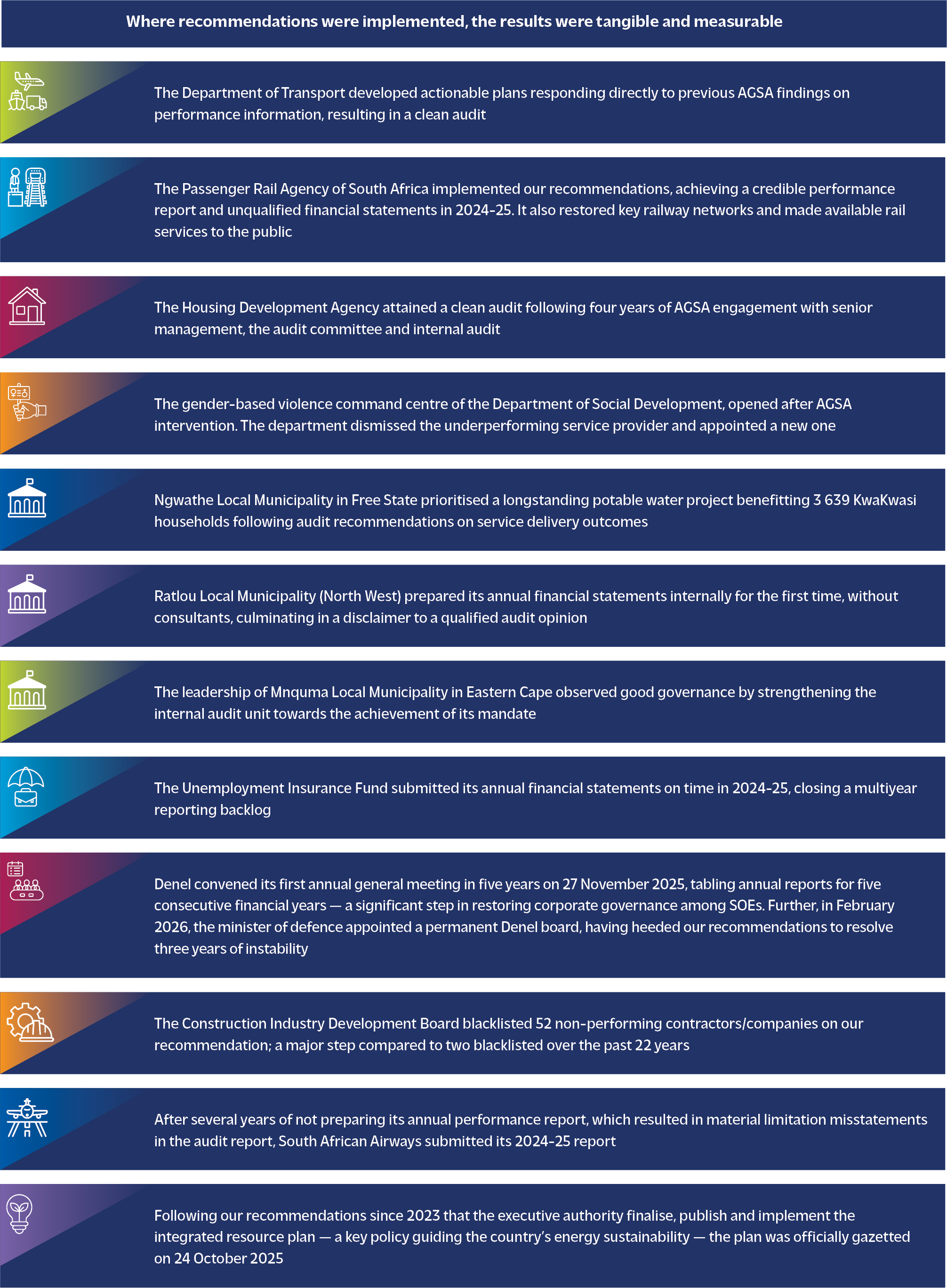
Notwithstanding these challenges, several ministers undertook the commitment process deliberately and rigorously. Before signing the commitment letter, the minister of transport required all entities to submit comprehensive audit response plans aligned to AGSA recommendations, including clear implementation timelines. These plans were subjected to internal departmental processes and formally endorsed by all deputy directors-general and the director-general before ministerial approval. Entity-specific annexures further strengthened accountability and traceability. This approach, carried over from the minister’s previous portfolio, underscores the importance of consistently setting the appropriate tone at the top.
The minister of human settlements also requested detailed action plans from all entities. These plans were scrutinised to ensure that key audit findings were adequately addressed before finalising commitments. The minister of environment submitted detailed progress reports on consequence management at both the Department of Forestry, Fisheries and the Environment and SANParks. The impact of embedding and institutionalising sound governance practices is evidenced by the former’s sustained clean audit outcome, despite a transition in political leadership.
The AGSA focus is now translating commitments into tangible outcomes. Our work demonstrates that signing commitments does not guarantee execution. Despite extensive insights relating to infrastructure risks, supply chain management deviations and weaknesses in reporting systems, behavioural change remains slow across several sectors, including metropolitan municipalities. While the AGSA’s insights are acknowledged, they are not consistently institutionalised or acted upon in a way that sustains improvement.
The next phase will activate oversight structures and coordinating institutions among non-responsive or tardy auditees. This includes targeted engagement with Scopa, the Portfolio Committee on Cooperative Governance and Traditional Affairs, National Treasury, premiers and provincial corporate governance and traditional affairs departments, supported by tailored insight summaries. These interventions will be deployed to enable corrective action, strengthen consequence management and reinforce accountability across the system.
Recommendations
The number of recommendations increased from 561 in 2024-25 to 815 in the review year, reflecting the expanded scope and coverage of our work. Against a target of 30% implementation at high-impact auditees, 176 recommendations were fully implemented by year end, with 207 on track for implementation. This is a 49% uptake, exceeding the targeted threshold.
Despite this, barriers continue to constrain wider implementation. These include leadership instability, prolonged investigations that delay consequence management, slow or weak responses stemming from limited buy‑in and lack of consequences for non‑implementation. Addressing these systemic constraints is crucial to accelerate uptake and translate recommendations into sustained improvements in audit outcomes.
Myap
Myap, now in its second year, addresses the country’s key macro risks. Over the year under review, it continued to strategically prioritise high-impact areas, including infrastructure, metropolitan municipalities, disclaimer auditees, human settlements, coordinating institutions, fiscal pressure, water and sanitation and skills and capacity. The following are among the key insights raised and influenced across focus areas:
Education
Education departments frequently achieve unqualified audit opinions. However, these are often accompanied by material findings on supply chain management, weak contract administration and noncompliance with procurement prescripts. In addition, shortcomings in the quality of performance information persist, including poorly defined indicators, weak alignment between plans and intended outcomes and insufficient supporting audit evidence.
While the sector demonstrates relative financial reporting stability, ongoing procurement weaknesses and ineffective consequence management perpetuate repeat findings across audit cycles. As a result, many education institutions remain doing the basics or not doing the basics, limiting progression to sustained good performance.
Developments that reflect emerging systemic use of AGSA insights in education, skills and unemployment
The president-led government effort voiced in the 2026 State of the Nation Address to reposition the focus of technical and vocational education and training colleges and sector education and training authorities is encouraging. It includes driving impactful skills development programmes that are responsive to labour market demands, improving governance, strengthening industry participation and enhancing training quality. These priorities are consistent with the AGSA’s longstanding insights, which have highlighted the misalignment between these entities’ programmes and labour market needs.
The Department of Higher Education and Training has initiated the phase-out of irrelevant legacy technical college programmes in favour of industryaligned occupational qualifications and practical skills development. This reform recognises that continued investment in misaligned programmes presents fiscal risks and undermines efforts to address youth unemployment. While still early, this move demonstrates how audit insights and sustained stakeholder engagement bring meaningful reform to support national economic priorities.
The findings of the most recent audit of the National Student Financial Aid Scheme were conveyed to the minister of higher education during engagements in the fourth quarter. These insights directly informed the ministerial interventions recently announced to restore the scheme to its previous standing. Notably, the minister incorporated the audit findings verbatim in announcing these interventions, reflecting strong leadership responsiveness to the AGSA’s insights.
State-owned public entities and key public entities
These PFMA auditees demonstrate some of the most acute and high-impact criteria failures. These entities frequently fail on financial sustainability, supply chain compliance and consequence management. Weak governance, unstable boards and executive leadership, complex procurement arrangements and reliance on fiscal support contribute to material misstatements, irregular expenditure and, in some cases, disclaimers or adverse opinions.
Failure to decisively address irregular expenditure and enforce accountability allows problems to compound. As a result, SOEs and major public entities disproportionately populate the doing harm category, with their failures carrying heightened fiscal, service delivery and reputational risk for the government.
Losses and high debt persist at entities such as the South African Broadcasting Corporation, the South African Post Office and Transnet, undermining both financial sustainability and service delivery. At the Road Accident Fund, the continued application of International Public Sector Accounting Standards 42 instead of Generally Recognising Accounting Practice 19 resulted in a repeat adverse audit opinion. This was compounded by failure to meet key claims‑processing targets and the loss of R35,6 million through payment interceptions, exposing significant control and governance weaknesses.
The minister of transport dissolved the fund’s board and cancelled the chief executive officer’s contract. The minister directed the interim board to withdraw litigation against the AGSA and to revert to Accounting Standards Board standards. Subsequently, the fund submitted Generally Recognised Accounting Practice-compliant interim financial statements and requested an early audit. Scopa initiated an oversight enquiry and the Legal Practice Council was summoned to account for the conduct of legal practitioners involved, reinforcing consequence management and accountability.
Water and sanitation
In December 2025, the institution released its first Special Water Sector Report, themed Source to supply: A shared responsibility for a water-resilient future. A comprehensive analysis of the water value chain, highlighting severe shortcomings. It assesses the roles and responsibilities of key institutions, identifies gaps in execution and outlines priorities to reverse trends and prevent further decline.
Infrastructure delivery across this value chain remains plagued by persistent and prolonged delays, with several projects extending years beyond their original completion timelines. Added to that is the 22% of available funding unspent, due primarily to implementation delays at water trading entities. Furthermore, 65% of assets under construction are associated with significantly delayed projects – a carrying value of R7,1 billion. Under schedule 6B infrastructure grants, numerous nationally funded projects particularly in bulk and municipal water infrastructure programmes are late. This situation places strain on water supply, causing prolonged water shortages and heightened service delivery risks.
Similarly, the bucket eradication programme has not met its targets since 2019-20, with no projects completed and only 23% of its MTEF budget spent. The installation of sanitation facilities without the bulk infrastructure has resulted in repeated deadline extensions, with average project completion having reached only 82,9% by March 2025. In several provinces, no progress has been recorded against sanitation targets, denying communities their constitutional right to dignity and increasing both health and service delivery risks.
Response to the report was immediate and significant. The Portfolio Committee on Water and Sanitation found it alarming and unacceptable, with criminal liability being considered for municipalities polluting water resources. The report went to the Presidency, where its alignment with Operation Vulindlela’s reform was discussed. The Presidency acknowledged strong alignment between the report’s findings and ongoing water sector reforms, particularly those being advanced through the national water crisis committee and its national water action plan.
ICT and cybersecurity
Across all eight metropolitan municipalities, the ICT control environment remains concerning. Systemic weaknesses persist in revenue management systems and customer service platforms, particularly user access management, incomplete or missing system logs and increasing reliance on manual workarounds. These deficiencies weaken the integrity and reliability of financial and service delivery information. ICT projects continue to be delayed or incomplete, due largely to weak project governance and project management capacity shortfalls.
Oversight is inadequate. Information technology steering committees are ineffective. Internal audit coverage of ICT controls and projects is insufficient. These gaps are exacerbated by capacity constraints, with most metropolitan municipalities reporting key vacancies in cybersecurity and project management. This increases exposure to cyber risks and limits and hinders stabilisation of core ICT initiatives.
During the 2024-25 PFMA audit cycle, cybersecurity weaknesses were identified at 45 auditees (64%), including 23 high-impact auditees. Of these, eight auditees (11%), four of which were high impact, had vulnerabilities that could be exploited if not urgently addressed.
Examples of our successes
Fraud risk indicators
During 2025-26, our multidisciplinary audit team assessed fraud data among 156 auditees across all provinces. This identified numerous high risks, including duplicate payments, supplier-employee bank account linkages, irregular invoicing, abnormal expenditure patterns and misalignment between payments and evidence of delivery. Provincially, notable risk concentrations were uncovered.
In Gauteng, the health department incurred security expenditure exceeding R1 billion, significantly higher than in comparable sectors. This insight enabled the AGSA to prioritise audit focus on security-related contracts, strengthening preventive and detective audit responses. These analytics, when combined with Financial Intelligence Centre intelligence on suspicious payment patterns, strengthened proactive and risk led audit responses.
During the 2024-25 MFMA cycle, the institution prioritised high risk audits, including, for the first time, a full scope supply chain management audit at one of the country’s largest metropolitan municipalities. This identified high impact material irregularities and an increase in referrals. Early mobilisation of data analytics capabilities and unit teams enabled escalation of key matters such as panels and deviations. This information was escalated for consequence management.
Our fraud-data analytics further highlighted serious financial and governance risks. At eThekwini Metropolitan Municipality, material discrepancies were identified in water-tanker invoicing, including claims that vehicles, among them a small hatchback vehicle, had delivered 10 000 litres of water. This matter was progressed as a material irregularity. In Ekurhuleni, 9 004 water meters and 4 487 electricity meters were reliant on estimated readings for 12 consecutive months, placing R991 million in billed consumption at risk. In addition, Financial Intelligence Centre requests identified flows of funds between companies and municipal officials, which were referred to the Directorate for Priority Crime Investigation.
Conclusion
The year under review reinforces the AGSA’s role as a catalyst for improved public sector accountability, governance and audit outcomes. The recommendations made and commitments secured provide a foundation for sustained leadership focus, particularly as municipalities prepare for post-election transitions. Looking ahead, emphasis will remain on followthrough, sharpening execution discipline, deepening governance oversight, enhancing audit responsiveness to emerging risks and sustaining the impact of AGSA insights through engagement, interventions and consequence management.
The recommendations and commitments obtained will guide leadership focus across auditees, particularly municipally, where incoming leadership, following expected post-election changes, will leverage these for strategic prioritisation and improved governance. The AGSA continues its pivotal role in generating insights for a more integrated and coordinated governmental response to recommendation implementation to address underlying weaknesses, build accountability and improve service delivery.