
Enforcement for impact
Performance against 2025-26 targets
| Key performance indicator | 2025-26 target | Year-end actual | Status |
|---|---|---|---|
| % of high-impact material irregularities (defined in the material irregularities manual) | 80% | 100% | |
| % material irregularities to whose timelines the AGSA has adhered (newly raised material irregularities) | 60% | 69% | |
| % of backlog material irregularities eradicated | 60% | 72,5% | |
| Auditor-general’s assessment of material irregularity system effectiveness | Favourable assessment | Favourable assessment |
High-impact material irregularities
In the year under review, 155 high-impact material irregularities were raised across the three spheres of government, highlighting systemic governance failures affecting communities, institutional integrity and service delivery.
More than half the irregularities were in local government, consistent with audit insights that point to significant governance and service delivery weaknesses, worsened by slow responsiveness to audit messages.
These 155 irregularities are part of a growing enforcement record spanning six years. Each reflects tangible consequences, including public funds lost, services not delivered, infrastructure projects abandoned and institutions unable to produce credible financial records or account for the public resources entrusted to them.
The irregularities are across high-impact auditees, key public entities and sectors. These include disclaimer auditees, metropolitan municipalities and critical sectors such as health, education, transport, safety and security, infrastructure, energy and human settlements. This underscores the accountability challenges confronting the public sector.
More broadly, 203 irregularities were reported in the 2024-25 PFMA and 516 in the 2024-25 MFMA general reports.
AGSA timeline adherence
The institution was 69% compliant with timelines for newly raised irregularities (108 of 156), driven by earlier identification of cases during the audit cycle, enhanced monitoring of milestones and more effective engagement with accounting officers. Procedural compliance made way for addressing causes and driving governance reform.
However, challenges remain. The complexity of highimpact matters, delays in accounting officer responses and capacity pressures during peak audit periods continue to hamper consistent adherence to timelines. In response, the institution has refined its material irregularities policy and manual, transitioning from standardised timelines to a more flexible, risk-based approach that determines timeframes by the nature and complexity of each matter, supported by strengthened leadership oversight to ensure both responsiveness and impact.
Nature of active material irregularities - PFMA: 203 at 31 August 2025 | MFMA: 16 at 31 January 2026
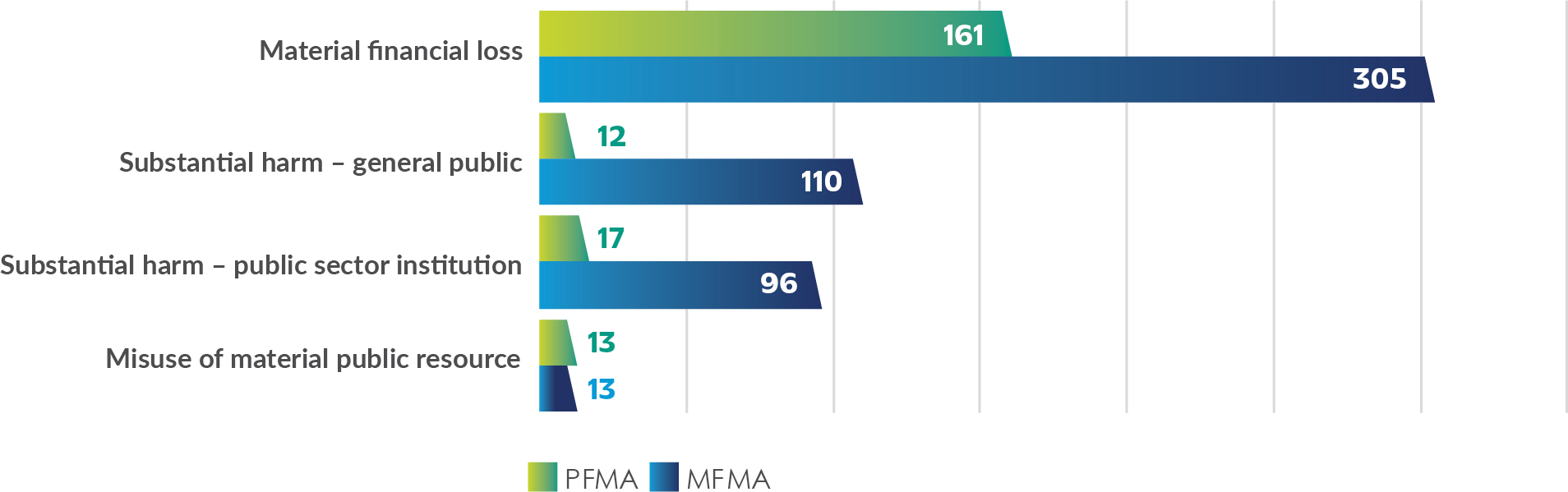
Sources: PFMA 2024-25 general report (cut-off 31 July/31 August 2025) | Draft MFMA 2024-25 general report (cut-off 31 December 2025/31 January 2026)
Status of active material irregularities
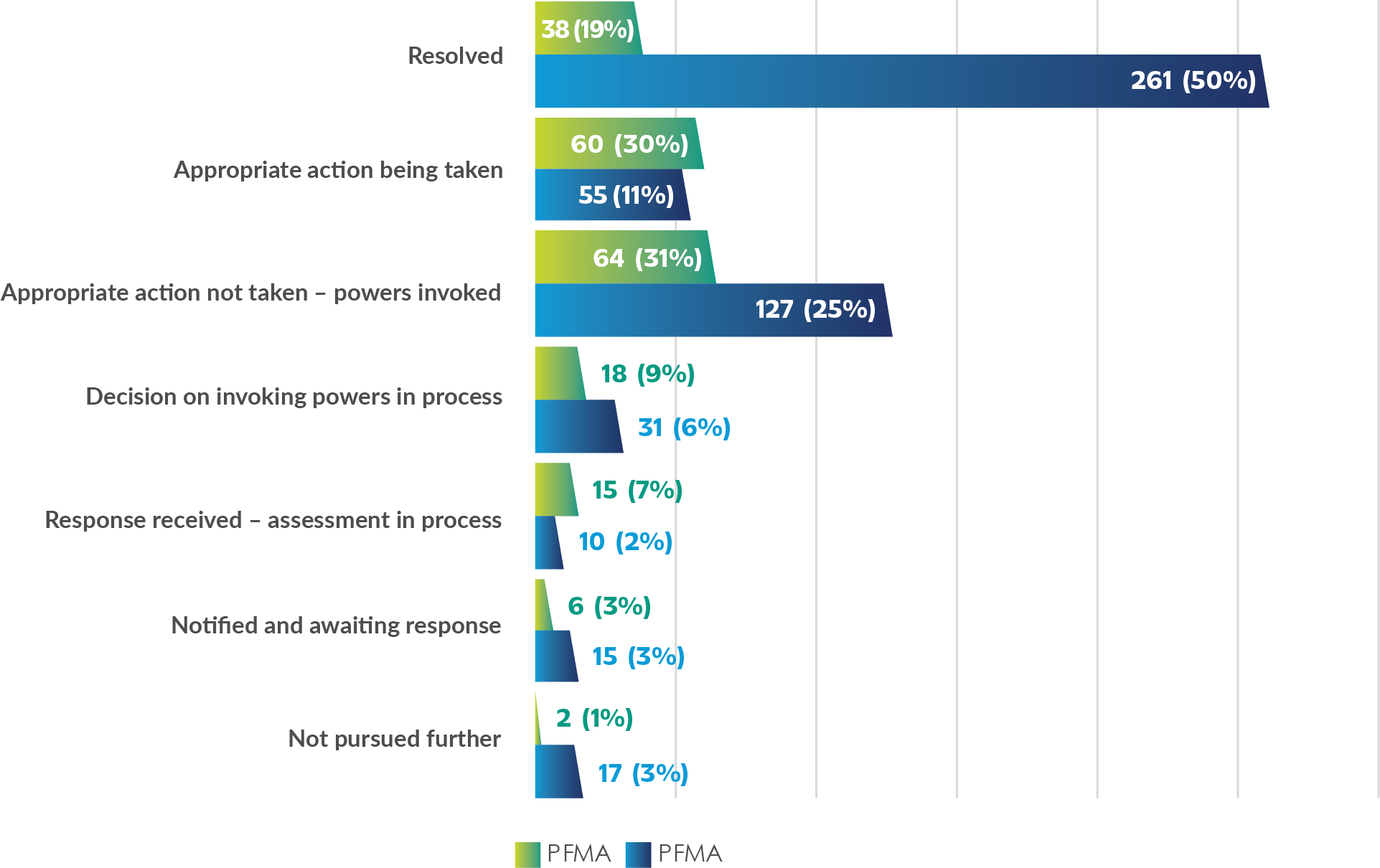
Sources: PFMA 2024-25 general report (cut-off 31 July/31 August 2025) | Draft MFMA 2024-25 general report (cut-off 31 December 2025/31 January 2026)
Eradication of backlog irregularities
By year-end, 69% of audit business units’ irregularities (77 of 111) and 76% of the backlog (62 of 82) had been cleared.
However, challenges persist, particularly in complex auditee environments such as prolonged investigations, delayed or incomplete recovery actions, systemic control weaknesses and leadership instability. Where responses from accounting officers have been inadequate, the institution has exercised its enforcement powers. This has included escalating matters through recommendations in audit reports and applying auditor-general referral and remedial action.
Our enforcement powers
In a defining moment for its expanded mandate, the institution issued its first certificate of debt – holding a municipal manager personally liable for a R4,6 million loss from overpayments for water tankering services. It sent a clear and unequivocal signal that failure to act carries real and direct consequences.
Recovery, however, does not follow automatically. It requires structured and proactive engagement with executive authorities responsible for driving recovery. The institution remains committed to supporting and closely monitoring the process to conclusion.
Beyond the initial certificate, a further 27 material irregularities that resulted in a financial loss to the state are currently being tracked along a defined critical path. The deterrent effect is already evident. In several instances, the progression towards a certificate of debt has prompted accounting officers to initiate recovery actions voluntarily, with additional time granted to allow these to conclude. This reflects the intended outcome of the process – accountability and corrective action.
Referrals to public bodies
Collaboration with the accountability ecosystem remains central to the institution’s enforcement strategy. Since inception, 116 material irregularities (2025-26: 53) have been referred to external public bodies for further investigation. These span the environment, financial losses, procurement irregularities, criminal conduct and maladministration.
Status of referrals
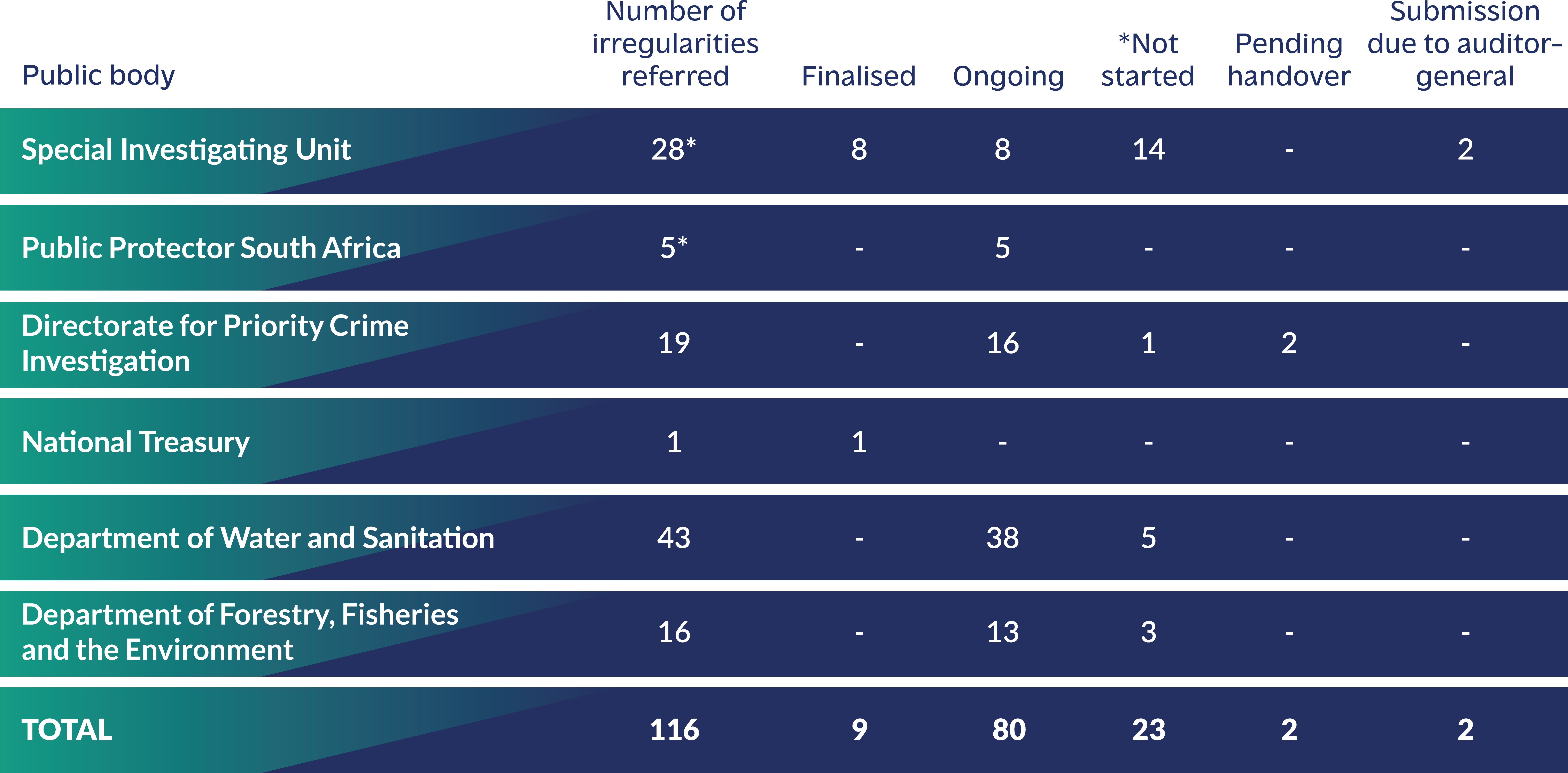
The referrals are yielding tangible results. Outcomes include the initiation of recovery proceedings, expanded investigations incorporating criminal referrals and supplier sanctions, legal action to set aside irregular contracts and measurable improvements in internal control environments. In the environmental sector, which accounts for just over half of all referrals, regulatory directives have been issued, criminal cases opened against noncompliant accounting officers and demonstrable improvements recorded at wastewater treatment works and landfills. Several matters have progressed to prosecution, with dockets finalised and cases re-enrolled for trial.
These outcomes reflect the institution’s commitment to safeguarding public resources not only through its enforcement, but through the effective activation of the accountability ecosystem.
Impact of the material irregularity process
Six years since the amendment of the PAA expanded the institution’s mandate, the material irregularity process has evolved from development into fully operational enforcement, with increasingly visible and tangible outcomes.
Across a growing number of auditees, accounting officers are strengthening internal controls, submitting overdue financial statements and performance reports, reducing disclaimed audit opinions, remediating environmental harm and applying governance responsibilities often before enforcement is introduced.
The Directorate for Priority Crime Investigation and the Special Investigating Unit collectively manage a substantial and complex portfolio of referrals, characterised by multiyear investigations with significant financial, legal and governance implications. Three matters with the Directorate for Priority Crime Investigation have moved past investigation – one is at court and two are at prosecution or docket decision stage. The remaining 14 cases are at various stages, supported by interagency collaboration to strengthen evidence. Recoveries remain limited, as emphasis is on taking matters through the criminal justice process.
Referrals to the Special Investigating Unit have generated significant outcomes, including eight completed investigations resulting in 28 criminal referrals, two civil litigations in the Special Tribunal, 16 administrative actions (blacklisting and regulatory body referrals), 23 systemic recommendations and 11 disciplinary referrals. While potential recoveries of about R1,13 billion have been identified, actual recoveries remain constrained due to early-stage enforcement processes and lengthy litigation timelines. Both entities continue to face systemic and external constraints – including legal process requirements, capacity limitations, documentation delays and reliance on multiple stakeholders – which slow investigation progression and finalisation. Despite steady progress, the pace of outcomes and recoveries remains inadequate, underscoring the need for targeted interventions to address bottlenecks and accelerate results.
Referrals of environmental irregularities to the Department of Water and Sanitation and the Department of Forestry, Fisheries and the Environment have produced tangible outcomes. Wastewater treatment works referrals have strengthened accountability and consequence management, with 25 cases progressing to criminal investigations, resulting in 17 prosecutorial actions and 14 court-sanctioned enforcements. These interventions have also driven urgency and responsiveness, contributing to measurable compliance improvements at several facilities, with some now fully operational. However, progress remains uneven due to ongoing structural and funding constraints.
Ten criminal investigations have been initiated for landfills, nine resulting in prosecutorial or courtsanctioned enforcements. This has increased the urgency with which municipalities address environmental noncompliance.
Progress is being made in recovering financial losses, but it is misaligned with the scale of the challenge. Recovery is inherently complex by the time losses are confirmed, traced and pursued. Constraints include prescription of debts, staff turnover and requirements to ensure fairness of the legal process. Investigations that precede recovery or consequence management are often complex, multiinstitutional and contested, with resolution extending over several years.
These dynamics do not reflect limitations of the irregularity process, but of the structural environment in which it operates. In response, the institution is engaging earlier, with clearer protocols and stronger coordination across the ecosystem. Prevention remains preferable to cure. The most significant indicator of a maturing system is not the number of certificates of debt issued, but the increasing number of accounting officers who take corrective action before escalation becomes necessary and strengthen control environments to prevent recurrence.
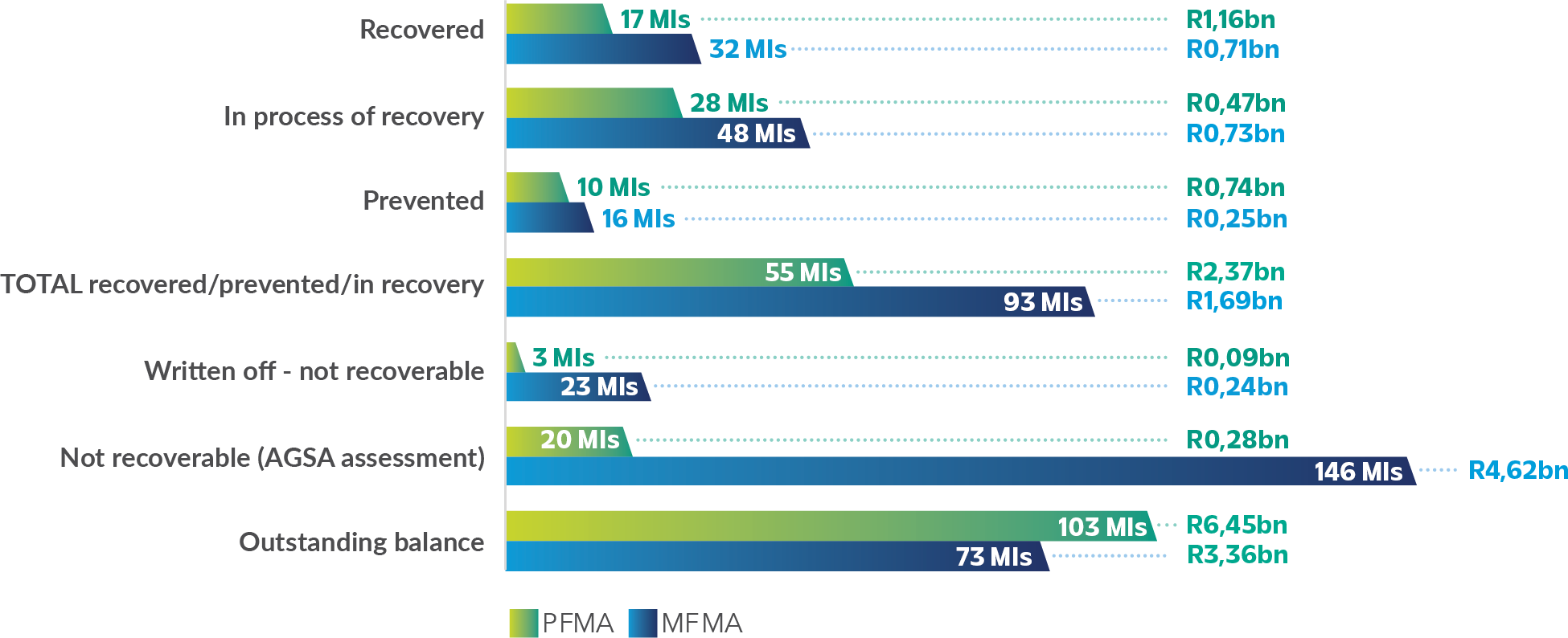
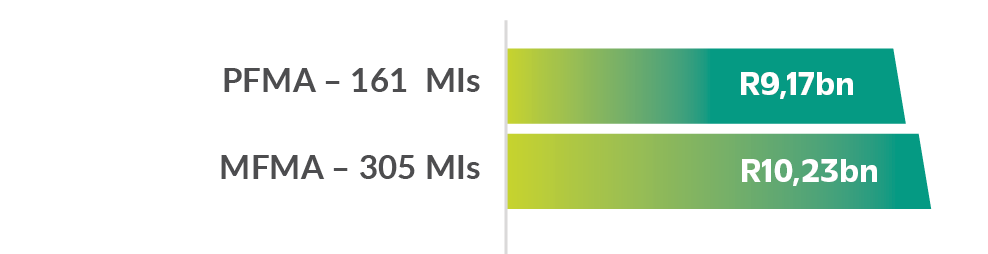
The graphic below further illustrates the financial and broader impact of the material irregularity process to date across both PFMA and MFMA environments.
Prevention and recovery of financial loss
Total estimated financial loss
Recovered/prevented/in recovery
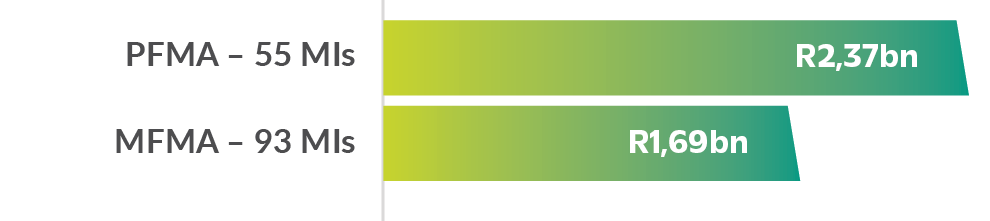
Sources: PFMA 2024-25 general report | Draft MFMA 2024-25 general report | Figures as at cut-off dates stated in respective documents
Additional impact of the material irregularity process
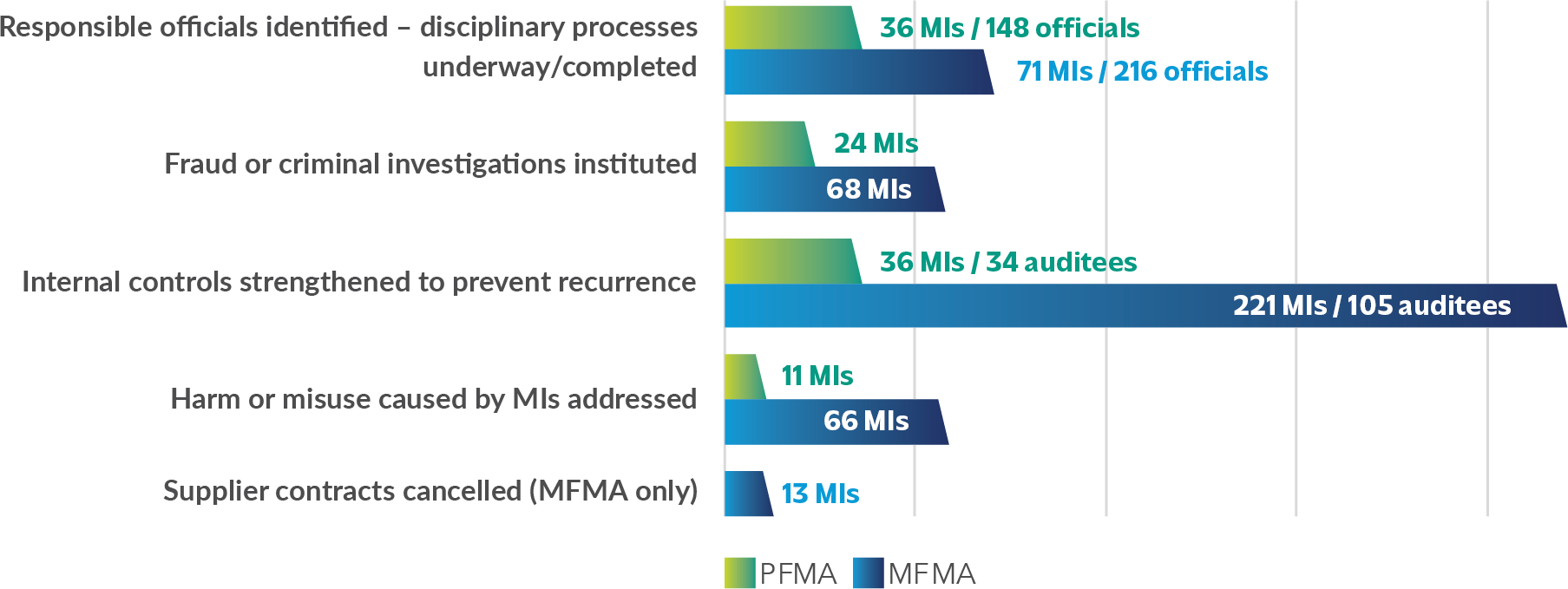
Further actions taken to address MIs
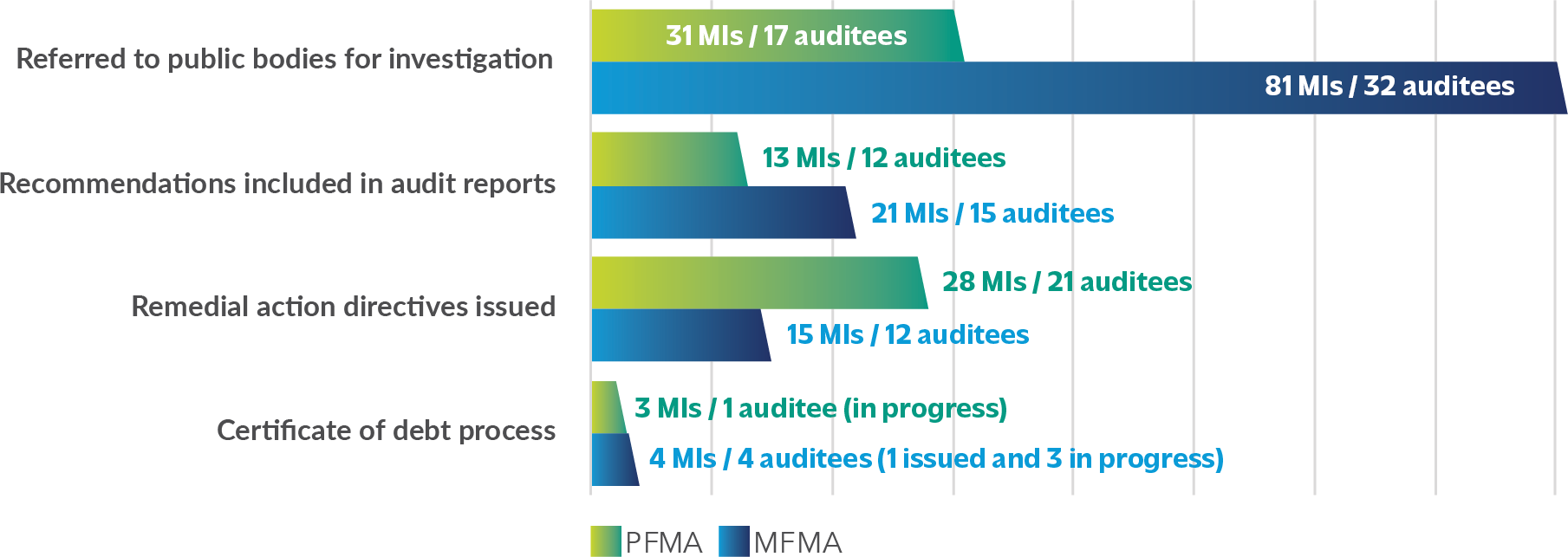
Identifying high-impact irregularities
Transversal
Focus on transversal matters across audit cycles and auditees has bolstered process consistency, reach and credibility. By identifying recurring failures that cut across institutions and spheres of government, isolated issue identification gave way to a more structured, systemic response, raising irregularities linked to common causes with increased speed, coherence and evidentiary consistency.
Transversal themes identified during the year included arrears in pension fund and medical aid contributions across multiple municipalities. Inadequate bank reconciliations and recordkeeping controls, and the non-submission or lack of credibility of annual financial statements and annual performance reports were also noted. Revenue losses arising from unbilled or uncollected charges for rates, electricity or water were identified across auditees as manifestations of control weaknesses.
This transversal lens also enhanced oversight of systems, assets and infrastructure. Information and communication technology irregularities were raised where crucial digital platforms were procured or operated without adequate controls, with a common pattern being significant public investment yielding limited or unverifiable public value. Infrastructure-related irregularities addressed projects characterised by poor workmanship, site abandonment or inadequate oversight, resulting in deteriorated or incomplete public assets. Misuse or underuse of resources including equipment, vehicles, systems and facilities was identified consistently across auditees.
Service delivery and public interest risks were a further area of transversal focus. A decline in the quality of drinking water and insufficient testing, excessive distribution losses in water and electricity networks and cyber incidents affecting the integrity of public institutions were identified across multiple auditees and pursued as systemic risks needing coordinated, multistakeholder intervention.
Link to irregular expenditure
Irregular expenditure that is not investigated is more than a compliance failure – it is a breakdown in consequence management. During the review year, we examined why qualifying irregular expenditure did not consistently translate into material irregularities and adjusted our approach.
Four material irregularities linked directly to irregular expenditure had not been investigated nor addressed. These matters reinforced our longstanding belief that irregular expenditure disclosed but not acted on perpetuates the very culture we strive to shift.
Fraud
Fraud remains inherently difficult to substantiate through audit evidence alone, particularly within procurement, where documentation is complex and not always accessible. During the year, one suspected fraud irregularity was raised, namely payments for water tankering services where evidence of actual delivery could not be substantiated, resulting in a likely financial loss of R1,6 million.
A further 23 cases indicating potential fraud were raised under noncompliance provisions. These included duplicate and intercepted payments, irregular invoicing and payments made for goods and services not received. We will continue to identify, investigate and pursue such matters.
Driving action
Engagement across all spheres of government with accounting officers, executive authorities, oversight structures and coordinating institutions reflects investment made to ensure that the material irregularity process is not only understood but acted on. Where engagement has been structured and sustained throughout the audit cycle, there are stronger accounting officer responses, more active monitoring by audit committees and increased executive authority involvement in supporting institutions to meet their obligations.
The process is also gaining traction beyond auditees directly affected. In the Eastern Cape, following an irregularity issued to Buffalo City Metropolitan Municipality on its water world fun park project, Scopa intensified its oversight of infrastructure programmes. Departments must now submit regular progress reports. Similarly, the Eastern Cape Portfolio Committee on Cooperative Governance and Traditional Affairs called on selected municipalities to account for their audit outcomes, infrastructure performance and service delivery impact.
Four transversal Sector Education and Training Authority related irregularities were escalated to the relevant portfolio committee and executive authority. All four accounting officers responded, marking a notable improvement from the past, when securing credible corrective action was a persistent challenge. We clarified the irregularity process with the South African Local Government Association, National Municipal Legal Practitioners Forum, including the implications of certificates of debt and the role of legal practitioners in supporting accounting officers once an irregularity is issued.
The Public Investment Corporation has integrated the irregularity process into internal audit action plans monitored by the audit committee. Department of Cooperative Governance internal audit functions supported the process through investigations and control assessments. In North West, internal audit units and audit committees have participated in progress reviews to assess the adequacy of management responses to irregularities.
Still, response across the ecosystem remains uneven. Sustained engagement does not consistently translate into effective implementation and, in several environments, oversight structures have not maintained consistent monitoring of irregularity progress. While responsiveness is increasing, sustained behavioural change has yet to be fully realised.
Conclusion
Six years ago, the expansion of the institution’s mandate moved from reporting on behaviour to shifting it. This is now starting to take hold. Accounting officers are responding earlier, oversight structures are routinely referencing irregularities in hearings and institutions that previously treated audit findings as administrative requirements are increasingly recognising them as governance obligations. While this shift is neither uniform nor complete, it is tangible and gathering momentum.
Areas that need strengthening are being acknowledged. Recovery of financial losses remains time consuming. Areas receiving attention are consistent conversion of fraud indicators and irregular expenditure into material irregularities and identification of breaches of fiduciary duty and uneven adherence to timelines.
In the year ahead, we will continue to focus on expediting high-impact irregularity cases and deepening collaboration across the ecosystem.
Audit operations
A significant achievement is the successful conclusion of the majority of PFMA and MFMA audits within the prescribed legislative timelines, with the 90% target being met.
Performance against 2025-26 targets
| Key performance indicator | 2025-26 target | Year-end actual | Status |
|---|---|---|---|
| % of audits completed within legislated timelines (excluding late submission of AFS) | 90% – 100% | 94,5% (PFMA – 94%; MFMA – 95%) | |
| % QC rating achieved | 80% – 90% (C1, C1#, C2 and C3 rating) | 92% |
Audits completed within legislated timelines
Our audit teams’ adherence to legislated timelines is a key part of how we, as the country’s supreme audit institution, ensure that we set the right example and operate by the high performance, accountability and institutional integrity that we espouse to auditees and other stakeholders. In 2025-26, we achieved a completion rate of 94,5%.
The levels of submission are no accident, but result from tactical strategies we deploy to shift the culture, using our influence and enforcement tools.
Deploying proactive measures to conclude a significant number of audits across MFMA and PFMA cycles is crucial. Such tactics include early planning and scoping, resulting in the timely conclusion of cycle approaches and working papers, disciplined and regular stakeholder engagement, coordinated resource management and tracking in-cycle milestones.Over the past year the AGSA concluded several backlog audits that existed due the non-submission of financials by various auditees.
- SAA – Financial statements were received on 30 September 2025 and the audit was finalised on 21 November 2025.
- SAA Technical – Financial statements were received on 22 July 2025 and the audit was finalised on 21 November 2025.
- Air Chefs – Financial statements were received on 30 July 2025 and the audit was finalised on 18 November 2025.
- Denel Vehicle Systems – Financial statements for the year 2022-23.
- Central Energy Fund – Financial statements were received on 18 August 2025 and the audit was finalised on 30 September 2025.
- Komatiland Forest – Financial statements were received on 30 September 2025 and the audit was finalised on 30 January 2026.
Audit quality
The quality of our audit work remains paramount, as it underpins the credibility of our opinions and strengthens our reputation. We are pleased to have achieved a 92% quality rating, a significant improvement from 82% in 2024-25.
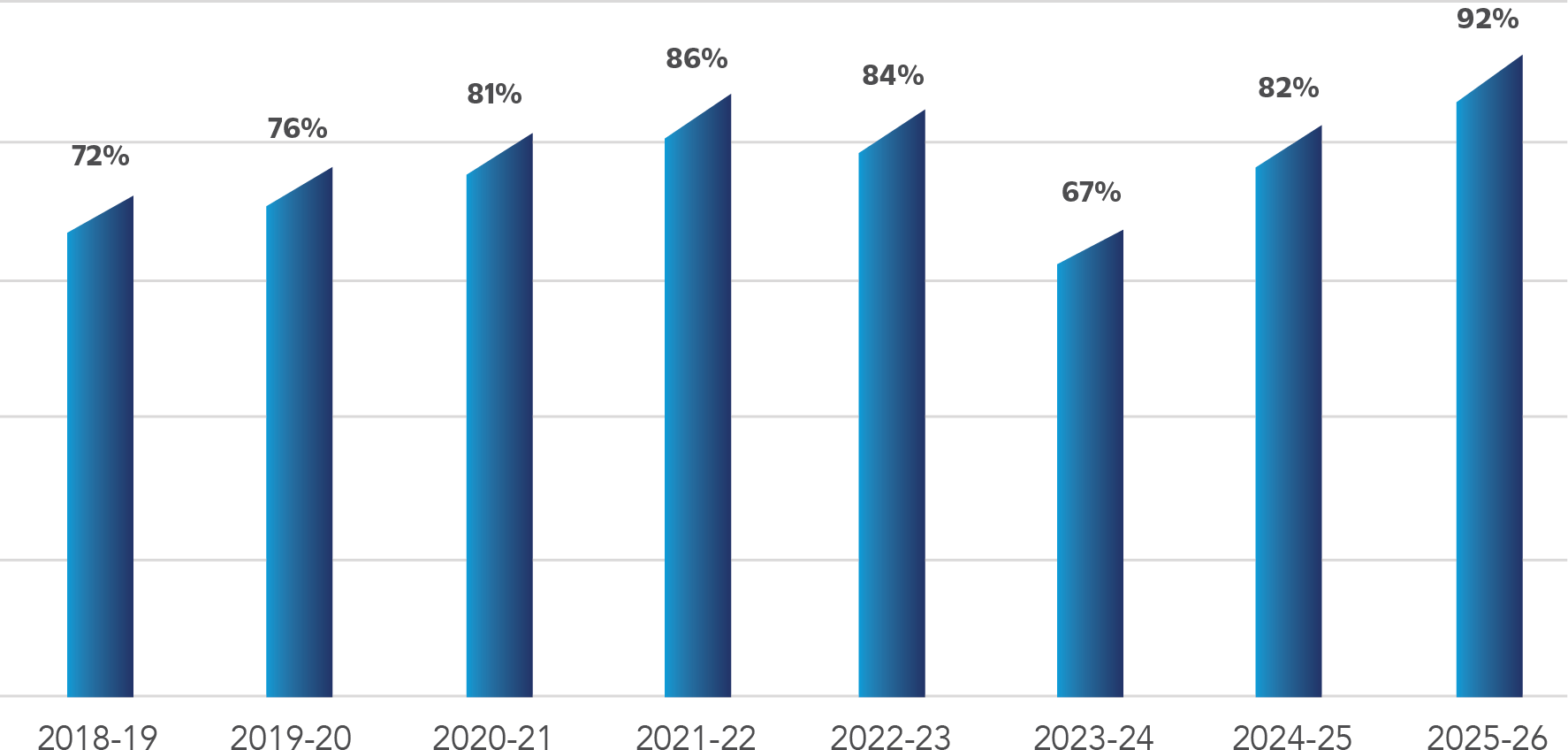
This is a testament to our intentional, sustained and consistent effort to implement key initiatives that enhanced audit quality and yielded consistent, compliant results.