
How we are governed
Corporate governance framework
The institution’s governance framework is anchored in the Constitution, the PAA and its associated regulations, and is aligned to recognised good governance practices. The institution adheres to the principles of King IV, reinforcing its commitment to ethical leadership, accountability and effective oversight. In line with best practice, membership within governance structures is periodically rotated and independent assessments are conducted to evaluate their effectiveness. In addition, the governance framework is continuously refined to strengthen leadership decisionmaking processes, enhance oversight and ensure ongoing alignment with the institution’s evolving strategic objectives.
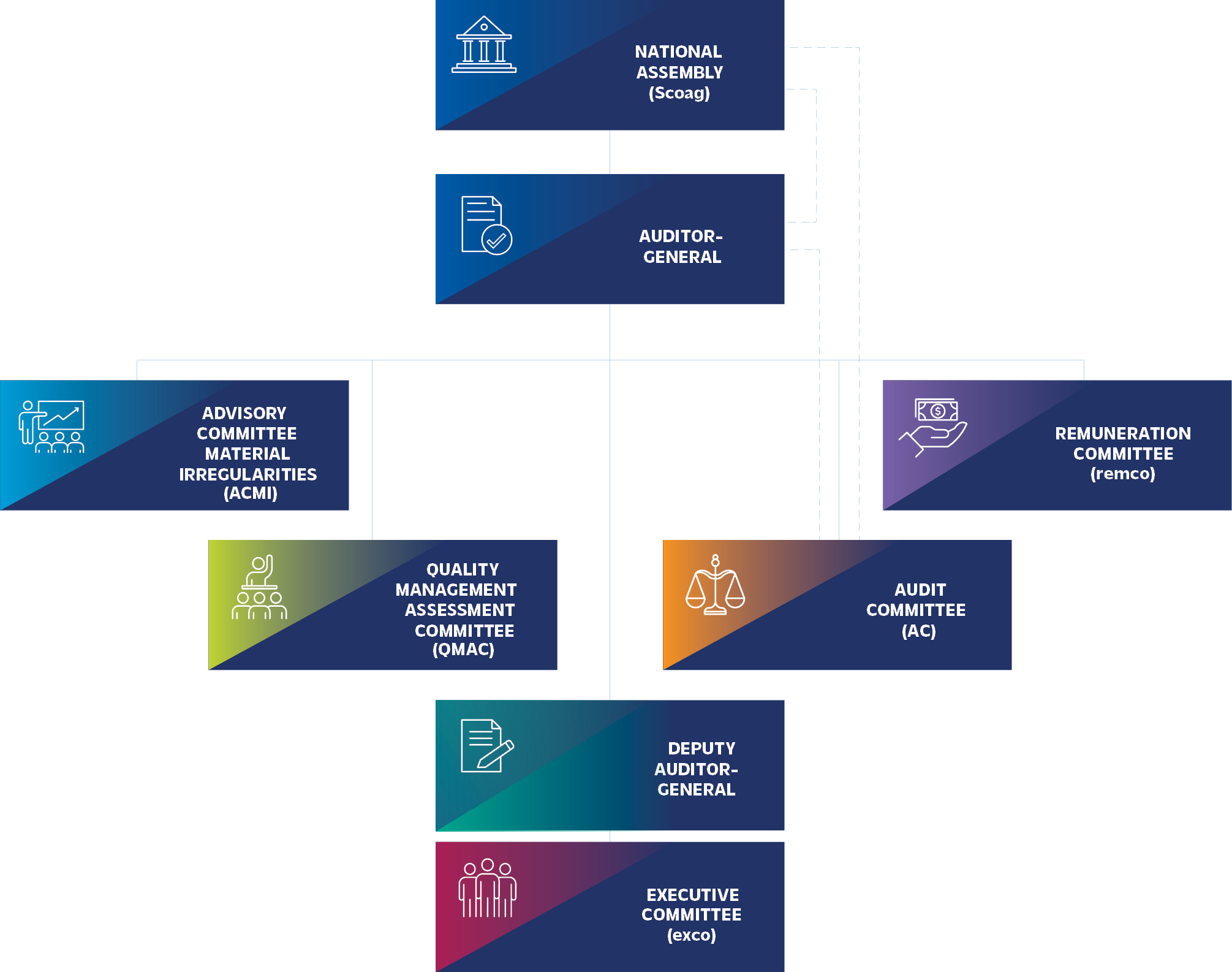
The National Assembly established Scoag as an oversight mechanism in accordance with section 55(2)(b)(ii) of the Constitution and section 10(3) of the PAA. The committee’s responsibilities are outlined below with the PAA section from which they are derived.
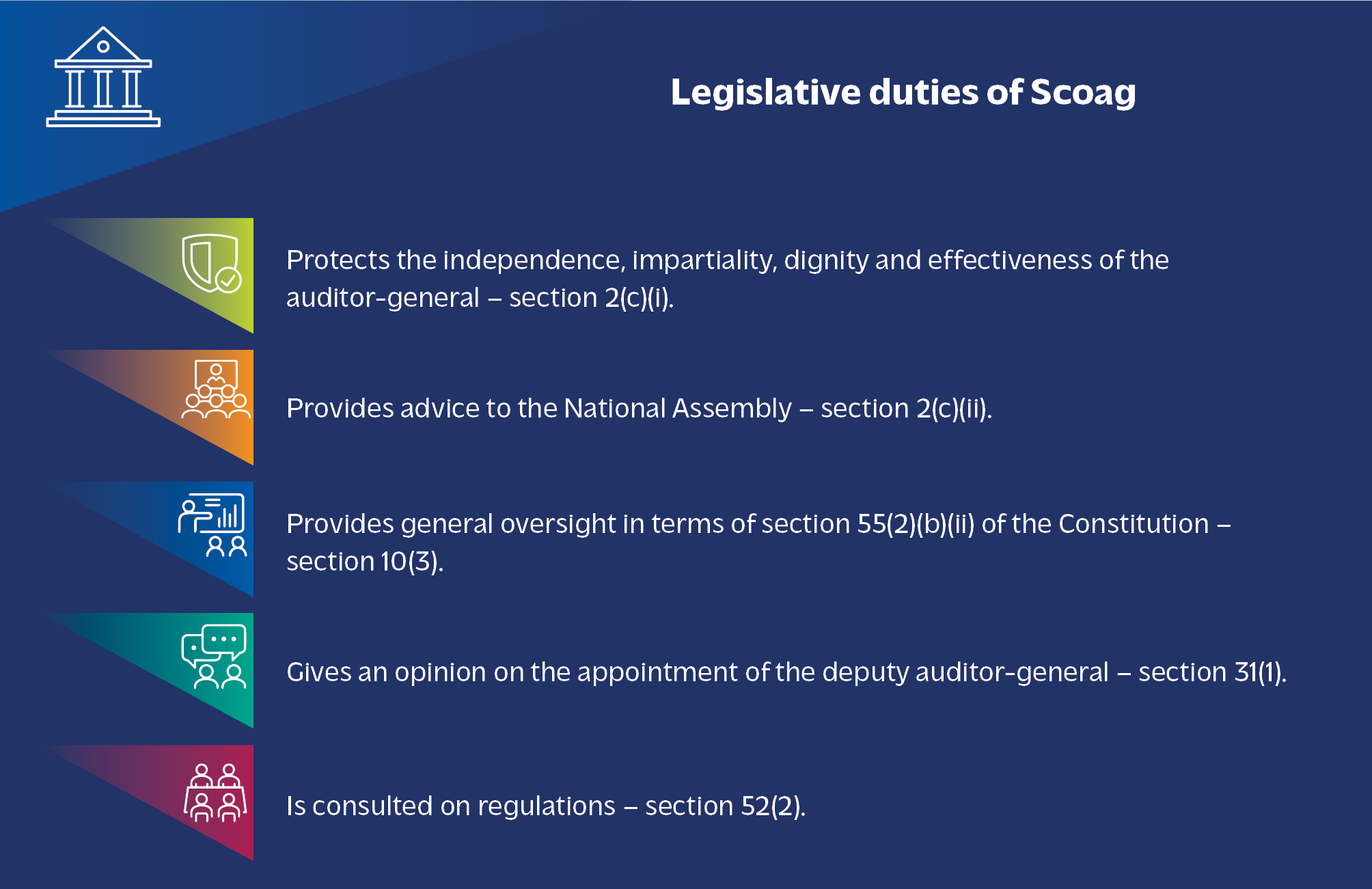
Advice and oversight to the National Assembly
Performance
Strategic plan and budget
- Considers the strategic plan and budget and recommends their submission to the speaker for tabling in the National Assembly – sections 38(2)(a) and 38(3).
- Provides an opinion on the basis for the calculation of audit fees prior to the auditor-general’s determination thereof – section 23(1).
- Considers reports from the deputy auditor-general on actual or impending revenue under collection, shortfalls in budgeted revenue and overspending of the budget or expenditure not in accordance with the budget – section 43(5)(b).
Annual report
- Considers the annual report, financial statements and audit report on these statements – section 41(5) read with sections 10(1) and (2).
- Considers requests for the retention of surplus funds – section 38(4).
- Considers audit committee reports – section 40(6)(b)(iii).
- Appoints an external auditor – section 39(1).
Audit matters
- Provides an opinion on the standards applied to audits, the nature and scope of audits and procedures for handling complaints when auditing – section 13(1)(a), (b), (c).
- Consults on the Code of conduct for authorised auditors – section 12(3)(b).
From 1 April 2025 to 31 March 2026, the AGSA briefed and obtained Scoag’s support on the AGSA’s 2026 – 29 strategic plan and budget, the latest audit directive and the 2024-25 integrated annual report. The AGSA also briefed the committee on other key matters, including the progress and impact of its material irregularities process, as well as on the Public Finance Management Act (PFMA) and Municipal Finance Management Act (MFMA) general reports.
Members
Freedom Front Plus
WW Wessels
(Chairperson)
Democratic Alliance
ERJ Spies
A Bateman
EJ Marais
SG Vilakazi
African National Congress
ML Mofokeng
SI Subrathie
TJ Bila
LE Ligaraba
N Maduna
uMkhonto we Sizwe Party
S Mwali
EK Madlala
Economic Freedom Fighters
NV Mente-Nkuna
Action SA
AD Beesley
Inkatha Freedom Party
MA Mncwango
Mandate
Section 5(2)(b) of the PAA states that the auditor-general may appoint advisory and other structures outside the administration of the auditor-general to provide specialised advice to the auditor-general. The quality management assessment committee, with the external members, is an oversight structure appointed in terms of s5(2)(b) by the auditor-general to consider quality management processes within the AGSA.
The quality management assessment committee oversees the AGSA’s system of quality management, based on input from the quality management business unit and the Independent Regulatory Board for Auditors. The committee ensures our adherence to professional standards and legal requirements and that our audit reports are in line with accepted international standards on auditing. All quality management monitoring review reports are submitted to the committee annually, which considers whether the quality management business unit has correctly evaluated the audit quality produced by engagement managers subjected to a quality review. The committee also reviews and approves our policies and processes for monitoring quality compliance.
The committee also supports the auditorgeneral in the evaluation of the system of quality management, per the International Standard on Quality Management (ISQM)1.
Members
The quality management assessment committee consists of the auditor-general, the deputy auditor-general, a member of the audit committee and an additional external member co-opted by the auditor-general.
Tsakani Maluleke, 51
(Chairperson)
Appointed: 2021
Attendance: 90%
Vonani Chauke, 50
Appointed: 2021
Resigned: February 2026
Attendance: 100%
Bongi Ngoma, 50
Appointed: 2026 (in her capacity as acting deputy auditor-general and from 1 June 2026, as deputy auditor-general)
Attendance: 100%
Grathel Motau CA(SA), 52
Appointed: 2022
Attendance: 100%
Retainer: R161 325
Experience: 29 years of business experience from both the public and private sectors in areas that include credit risk, financial analysis, financial management and reporting, auditing, due diligence, corporate governance, supply chain management.
Zubair Wadee CA(SA), 48
Appointed: 2023
Attendance: 100%
Retainer: R161 325
Experience: A chartered accountant (SA) with extensive experience in corporate governance and institutional leadership, having spent many years in a large audit firm and academia. He has served on a number of governance, integrated reporting and accounting committees both locally and internationally.
Key committee considerations during 2025-26
- Approve the system of quality management (SoQM) external review programme – 18 November 2025
- Review the policy on monitoring, remediation, evaluation and documentation of the AGSA SoQM – 18 November 2025
- Key audit team members from the AGSA joining auditees – feedback provided to the committee at every meeting. This matter was elevated to the committee because of the reputational risk it presents to the institution if not properly managed. There is always a need to ensure that when AGSA employees join auditees, there are mechanisms in place to ensure the continued integrity of our audit work and our final outcomes, with no conflicts created (whether real or perceived).
- Approve the ISQM methodology end to end 13 June 2025
- Engage on the AGSA’s quality management review process and confirm the final quality ratings allocated to the reviewed engagement files
Mandate
The advisory committee on material irregularities was established in terms of section 5(2)(b) of the PAA. Its core mandate is to hear oral representations by accounting officers and members of accounting authorities in respect of the auditor-general’s consideration to issue a certificate of debt in cases where a material irregularity has resulted in a financial loss by the state. The committee is further mandated to advise the auditor-general on the issuing of a certificate of debt. The committee is independent and comprises multiskilled and professionally qualified members appointed by the auditor-general. The Material Irregularity unit provides administrative services to the committee.
Members
Nano Matlala
(Chairperson)
Appointed: February 2023
Attendance: 100%
Professional fee: R581 000
Herman Tlhako
Registered auditor
Appointed: October 2022
Attendance: 83%
Professional fee: R347 215
Ina Botha
Legal
Appointed: October 2022
Attendance: 100%
Professional fee: R456 512
Grant Dunnington*
Financial
Appointed: July 2022
Attendance: 0%
Professional fee: R0
Key advisory committee on material irregularities considerations during 2025-26
The committee met five times during the year to consider the following material irregularities
- Ngaka Modiri Molema water tankering material irregularity
- Free State Department of Human Settlements (three material irregularities)
One workshop was held on 22 October 2025 to discuss administrative and material irregularity process matters
*During the year, there was no matter that required the member’s expertise. Hence, the member did not attend any meetings for the financial year.
Mandate
Section 40(1) of the PAA mandates the auditor-general to establish an audit committee and appoint its members. The committee does not have managerial responsibility, but reports to the auditorgeneral and Scoag on:
- whether the institution’s internal controls and system of risk management are adequate and effective.
- its evaluation of the annual financial statements.
- whether the chief financial officer and finance function have the financial expertise to fulfil their responsibilities.
Members
The committee consists of four independent, nonexecutive members. Their skills and competencies are aligned to their duties and include business, financial, risk management and information technology matters.
Grathel Motau, 52
(Chairperson) CA(SA)
Appointed: 2022
Attendance: 100%
Retainer: R376 126
Experience: 29 years of business experience in both public and private sectors, including credit risk, financial analysis, financial management and reporting, auditing, due diligence, corporate governance, supply chain management.
Carol Roskruge, 53
MSc (UKZN); MBL (Unisa SBL)
Appointed: 2016
Attendance: 100%
Retainer: R322 649
Experience: Generalist trained in commercial and supply chain management. She has extensive audit, risk and compliance management experience gained from her tenure on committees across the public and private sectors. She is an entrepreneur, an independent non-executive director and a businesswoman.
Cedrick Mampuru, 51
CA(SA)
Appointed: 2018
Attendance: 100%
Retainer: R322 649
Experience: More than 20 years in debt and equity structuring, risk and financial management.
Sello Ernest Mmakau, 52
Master of Business Leadership
Appointed: July 2024
Attendance: 60%
Retainer: R564 635*
Experience: Transformation executive with 24 years of experience in technology, known for his innovative approach to defining groupwide digital strategies and setting institutional visions.
* This figure is higher than usual because of a rollover of the member’s fees from 2024-25 (in 2024-25, the member had opted to donate his fees to a charity of his choice but this could not be processed as the charity was not on the institution’s approved procurement and payments list. As a result, the fees he had wanted donated were paid to him directly instead during 2025-26)
Key committee considerations during 2025-26
The audit committee met five times during the year to consider and, where appropriate, approve:
- Internal controls and the AGSA’s risk management framework, key strategic risks and mitigations rollout
- Internal and external audit processes and reports
- The integrated annual report and audited financial statements
- The AGSA’s sustainability and performance information
- The internal audit workplan
- The ability of our chief financial officer and finance function to fulfil their responsibilities
- Annual assessment of audit committee members, and internal and external auditors
Mandate
Section 5(2)(b) of the PAA mandates the auditor-general to appoint a remuneration committee. This committee makes recommendations to the Independent Commission for the Remuneration of Public Officebearers on the salary, allowances and benefits of the auditor-general. The committee also makes recommendations to the auditorgeneral on the conditions of employment, remuneration, allowances and benefits of the employees of the AGSA before the auditorgeneral decides. It also provides advice on industry developments in remuneration frameworks. The committee is reviewed annually for independence.
Members
The committee comprises the deputy auditor-general and three external members.
Tantaswa Fubu, 53
CA(SA), BAdmin (Honours)
Appointed: 2022
Attendance: 100%
Retainer: R188 063
Experience: More than 30 years’ experience in audit, human resources and corporate governance, including in listed companies.
Victor Emmanuel Sifiso Cele, 49
MBA (GIBS), GEDP (GIBS), BSocSc (Hons), BSocSc (UCT), MHRP
Appointed: 2023
Attendance: 100%
Retainer: R161 325
Experience: 26 years’ experience in human capital in fast-moving consumer goods and financial services sector specialising in human resources/human capital and 10+ years of experience as a non-executive director and remco member.
Nazlie Samodien, 55
Master Reward Specialist
Appointed: 2009
Attendance: 100%
Retainer: R161 325
Experience: 10 years of generalist human resources experience and over 16 years in specialist remuneration.
Vonani Chauke, 50
Appointed: 2021
Resigned: February 2026
Attendance: 100%
Key committee considerations during 2025-26
- Performance-based salary increase proposal
- Revised remuneration benchmarking of the auditor-general (continued benchmarking and engagement with the Independent Commission for the Remuneration of Public Officebearers on auditor-general remuneration)
- Executive job grading outcome
- Financial performance of the institution for the year
- Performance bonus recommendations (2025-26)
- Latest trends in remuneration committee mandates
Mandate
The executive committee (exco) supports the deputy auditor-general in overseeing and managing the institution’s business affairs, in accordance with the delegated authority prescribed in the AGSA management approval framework. The committee is also empowered to establish subcommittees to support the execution of its responsibilities. Chaired by the deputy auditor-general, the committee comprises the head of audit, the head of specialised audit services, the chief financial officer, chief risk officer, chief technology officer and a chief people officer. The committee convenes monthly and, where necessary, holds special meetings to address ad hoc governance matters.
Members
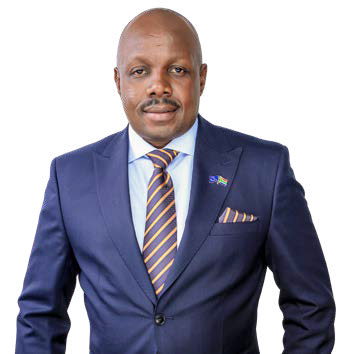
Vonani Chauke*, 50
Deputy Auditor-General CA(SA), Cisa, CIA
Attendance: 100%
Experience: Audit
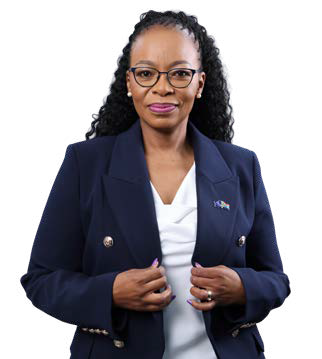
Bongi Ngoma, 50
**Acting Deputy Auditor-General
CA(SA)
Attendance: 100%
Experience: Audit
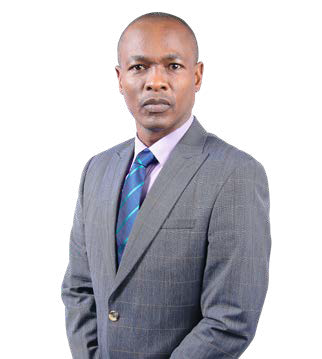
Dr Thamsanqa Zikode, 51
**Acting Head of Audit
CA(SA), MAP, MBA, M Phil and DBA
Attendance: 100%
Experience: Audit and financial management and analysis
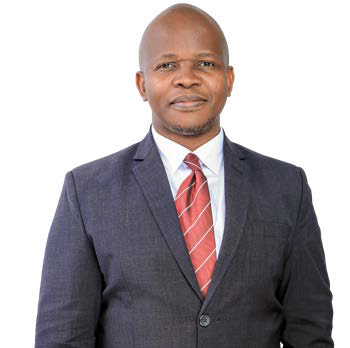
Polani Sokombela, 42
Chief Financial Officer CA(SA)
Attendance: 100%
Experience: Audit
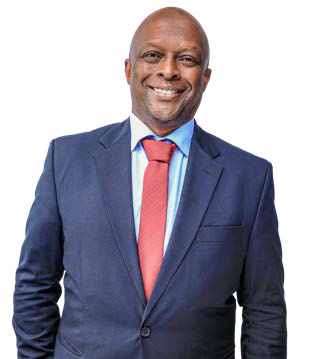
Phila Ndarana, 58
Chief Technology Officer BCom, MDP, PG Diploma in data technology
Attendance: 100%
Experience: Information technology, banking and insurance
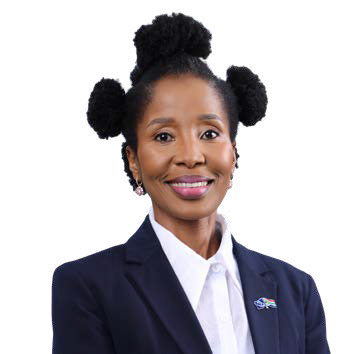
Vatiswa Nthoesane, 52
Chief People Officer
MBL
Attendance: 100%
Experience: Human resources, financial services and public sector
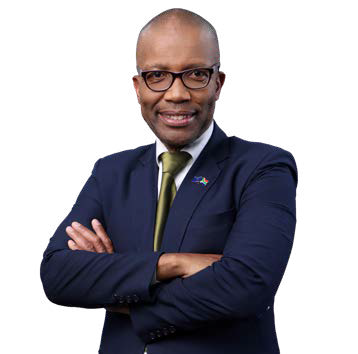
Solly Segooa, 52
Chief Risk Officer
CA(SA)
Attendance: 100%
Experience: Audit, banking services and mining
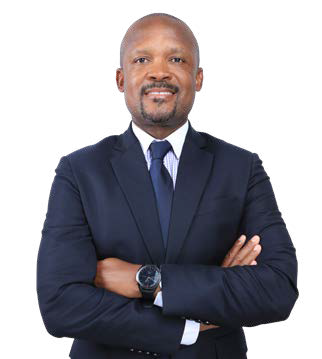
Thato Mahlamvu, 46
Head of Specialised Audit Services
BSc information systems, MBA
Attendance: 100%
Experience: Professional services industry
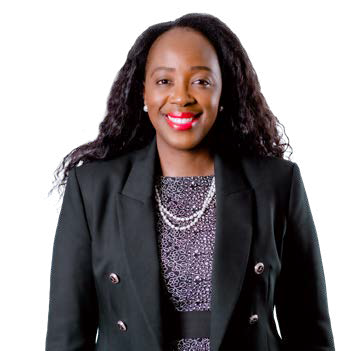
Lindiwe Miyambu*, 54
Chief People Officer BEd
Attendance: 100%
Experience: Financial services
*Resigned
**Both acting positions were due to the former deputy auditor-general’s resignation and were put in place to ensure continued stable operations and continuity while the recruitment processes were underway.