
Governance and accountability reports
Introduction
- In line with paragraph 13 of the International Standard on Quality Management 1 (ISQM 1) (the standard),1 the annual evaluation of the AGSA’s System of Quality Management (SoQM) was performed on 18 November 2025.
- This report supports the communication requirements of paragraph 33(d)(ii) of the standard.2
- I am pleased to report on the conclusion reached from my evaluation of the AGSA’s SoQM.
The design and operation of the SoQM
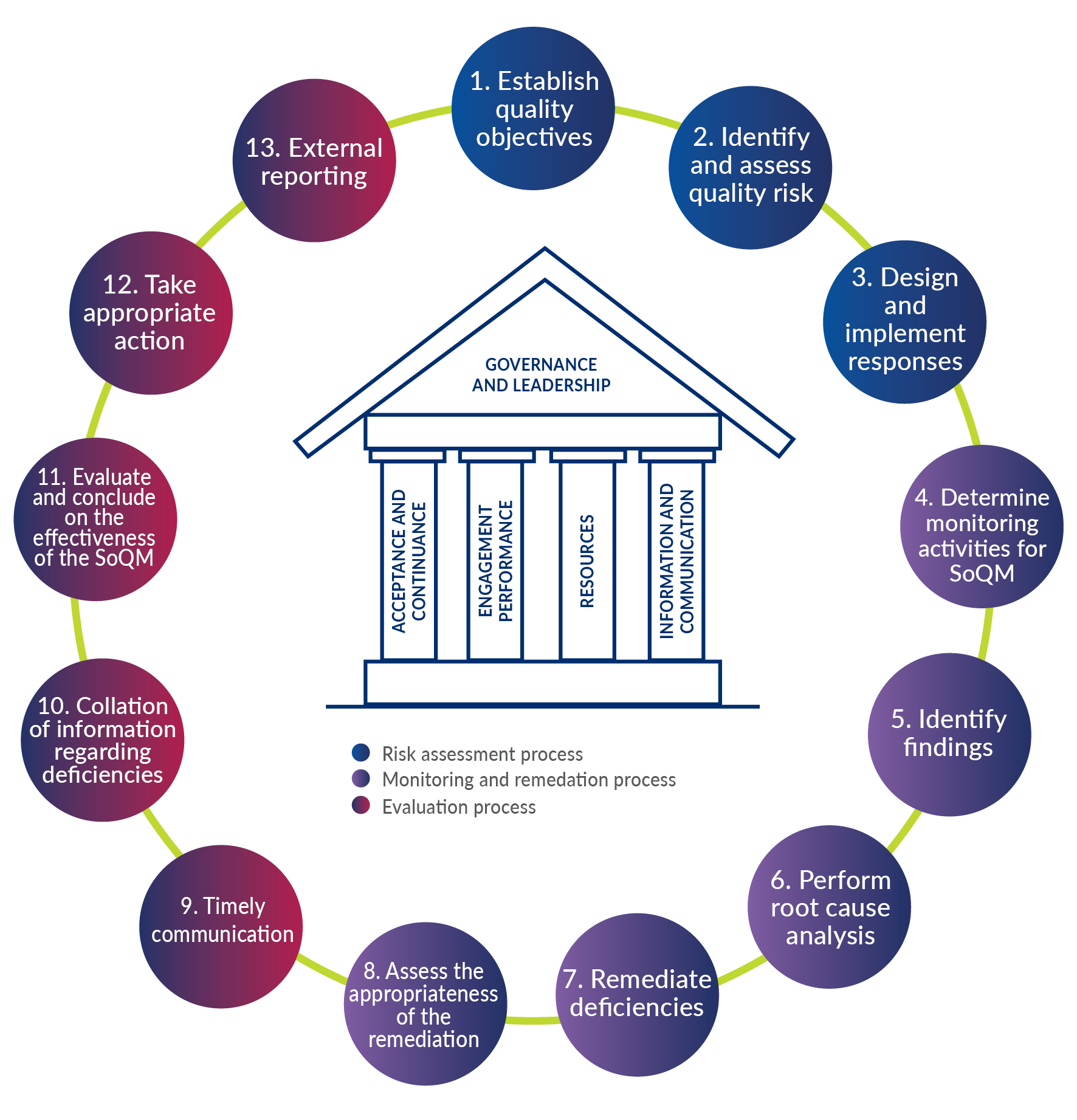
- The SoQM has been designed to address all the following eight components of the standard, taking into account the nature and circumstances of the firm as well as the nature and circumstances of the engagements performed by the firm:
a) The firm’s risk assessment process
b) Governance and leadership
c) Relevant ethical requirements
d) Acceptance and continuance of client relationships and specific engagements e) Engagement performance
f) Resources
g) Information and communication
h) The monitoring and remediation process. - The standard requires the firm to apply a risk-based approach to designing, implementing and operating the components of the SoQM in an interconnected and coordinated manner such that the firm proactively manages the quality of engagements performed by the firm.
- The AGSA’s SoQM has therefore been designed and operates as follows:
Responsibilities of the auditor-general and deputy auditor-general for the AGSA’s SoQM
- As the auditor-general, I assume ultimate responsibility and accountability for the AGSA’s SoQM in line with the AGSA’s audit mandate from the Public Audit Act 25 of 2004 (PAA).
- The deputy auditor-general, who has a direct line of communication with me, is assigned operational responsibility. The deputy auditor-general has, in turn, assigned certain operational responsibilities for the components of the SoQM to individuals with sufficient and appropriate experience and knowledge, as well as the necessary authority to assume the operational responsibilities.
Evaluating the operating effectiveness of the AGSA’s SoQM
- Paragraph 53 of the standard states, “The individual(s) assigned ultimate responsibility and accountability for the system of quality management shall evaluate, on behalf of the firm, the system of quality management. The evaluation shall be undertaken as of a point in time and performed at least annually.”
- In line with the guidance provided in the standard,3 I evaluated the AGSA’s SoQM, supported by the quality management assessment committee (QMAC), on 18 November 2025.
- In evaluating the SoQM, we considered the outcomes from the monitoring and remediation process. In using the results, the following were taken into account:
- The severity and pervasiveness of identified deficiencies, and the effect on achieving the SoQM objectives.
- Whether remedial actions have been designed and implemented by the firm, and whether the remedial actions taken up to the time of the evaluation are effective.
- Whether we have appropriately corrected the effect of the identified deficiencies on the SoQM.
- engagement reports issued by the AGSA, engagement managers or any other delegated signatories are appropriate in the circumstances.
The conclusion reached on the evaluation of the SoQM
- Based on the evidence considered, I am satisfied that the AGSA’s SoQM provides the firm with reasonable assurance that:
- The AGSA and its personnel fulfil their responsibilities in accordance with professional standards and applicable legal and regulatory requirements, and conduct engagements in accordance with such standards and requirements.
- Engagement reports issued by the AGSA, engagement managers or any other delegated signatories are appropriate in the circumstances.
Context for the conclusion
- In discharging my allocated responsibilities of ultimate accountability and responsibility for the AGSA’s SoQM,
- I considered the committee’s recommendation, as resolved at the QMAC meeting held on 18 November 2025
- I applied my professional judgement on the supporting evidence submitted from the AGSA’s quality management processes.
I believe that the SoQM evidence I have received is sufficient and appropriate to provide a basis for my conclusion.
Tsakani Maluleke
Auditor-General
Pretoria
22 November 2026
1 Paragraph 13 of ISQM 1: “Systems of quality management in compliance with this ISQM are required to be designed and implemented by December 15, 2022, and the evaluation of the system of quality management required by paragraphs 53–54 of this ISQM is required to be performed within one year following December 15, 2022.”
2 Paragraph 33(d)(ii) of ISQM 1: “Information is communicated externally when required by law, regulation or professional standards, or to support external parties’ understanding of the system of quality management.”
3 The individual(s) assigned ultimate responsibility and accountability for the system of quality management may be assisted by other individuals in performing the evaluation. Nevertheless, the individual(s) assigned ultimate responsibility and accountability for the system of quality management remains responsible and accountable for the evaluation.
1. Introduction
The remuneration committee (remco) is an advisory committee of the auditor-general operating in accordance with its approved terms of reference. The committee provides strategic guidance on remuneration, performance-related rewards and other people-related matters to ensure alignment with the institution’s mandate, financial sustainability and employee value proposition. This report outlines the committee’s key deliberations, decisions and achievements for the year under review.
2. Remuneration committee membership and meetings
The remuneration committee consisted of the following members for 2025-26:
| Remco member | Position in remco |
|---|---|
| Tantaswa Fubu | Chairperson |
| Sifiso Cele | Member |
| Nazlie Samodien | Member |
| Vonani Chauke (DAG) | Member (resigned February 2026) |
| Sibongiseni Ngoma (Acting DAG) | Member (appointed March 2026) |
During the financial year, remco held three formal meetings and two workshops:
- 28 July 2025
- 9 March 2026
- 19 March 2026 (special remco meeting)
Remco workshops
- 27 May 2025: Focusing on the revised auditorgeneral market remuneration, exco job grading outcome, feedback on the AGSA employee benefits broker and feedback on people strategy roadshows. Members in attendance included independent and internal representatives, who provided oversight and strategic input across a wide range of remuneration and people practices.
- 9 March 2026: Focusing revised 2026 auditor-general remuneration benchmarking report and latest trends in remuneration committee mandates: best practices when it comes to dual mandates / overlapping committee work.
3. Key matters considered
3.1 Annual salary increase
The committee annually deliberates on the proposed salary adjustment percentages considering institutional affordability, prevailing macroeconomic conditions, and market benchmarking. Consideration was also given to the relationship between salary increases and audit fees, ensuring that the institution does not fall materially behind competitors in the remuneration of critical skills, while maintaining an appropriate balance between these competing priorities.
Consistent with AGSA’s remuneration philosophy, salary increases are determined through a performance-based approach, integrated with compa-ratio considerations to proactively address pay inequities and promote fair, and sustainable remuneration practices over time.
In line with this philosophy, the following average salary adjustments were recommended in March 2026:
- 3% HoP and above
- 3,5% DBUL/BUL; and
- 4% senior managers and below.
The differentiated increase structure reflects the institution’s commitment to rewarding performance, maintaining internal equity, and ensuring market competitiveness, while balancing affordability considerations and fiscal sustainability. This approach supports AGSA’s high-performance culture and reinforces prudent financial stewardship.
3.2 Revised remuneration benchmarking of the auditor-general (continued benchmarking and engagement with the Independent Remuneration Commission (IRC) on auditor-general remuneration)
The committee considered an independent remuneration benchmarking review of the auditorgeneral position conducted by 21st Century. The review confirmed that the auditor-general’s fixed remuneration package remains competitive relative to most publicsector comparators and is broadly aligned with market benchmarks. However, when total remuneration was compared with a broader set of comparators, including private-sector and large audit firm chief executives, the auditor-general’s remuneration was positioned below the benchmark due to, among others the absence of short-term incentive arrangements and lower longterm incentive values.
The committee noted that while the remuneration package remains broadly competitive within the public sector, there are indications that it is beginning to lag certain benchmark levels, with potential retention implications. The committee further noted that recent remuneration increases at selected public-sector entities were driven by specific recruitment and retention considerations and should not be viewed as representative of broader market trends.
The committee resolved to engage with the Independent Remuneration Commission (IRC) and the Presidency, in accordance with the Public Audit Act, to share the benchmarking outcomes and facilitate consultation on the auditor-general’s remuneration. The committee also requested additional benchmarking analysis to provide further context to the findings.
3.3 Financial performance of the institution for the year
The committee noted AGSA’s strong financial performance and continued financial resilience despite ongoing fiscal pressures across the public sector. Audit income exceeded budget and grew year-on-year, supported by increased own hours revenue, strategic workforce initiatives and the continued success of resource pooling arrangements. These initiatives reduced reliance on contracted work, improved operational efficiency and contributed positively to revenue growth.
The committee recognised management’s focus on enhancing productivity and efficiency through digital transformation and revised pricing strategies. While productivity and recoverability measures remained below target, this reflected a deliberate shift away from a time-based approach towards more efficient audit delivery and value creation. The committee noted management’s efforts to identify an optimal balance between productivity, recoverability and financial sustainability, supported by the gradual transition to value-based pricing models.
Strong debt collection and disciplined working capital management contributed to an improved cash position and strengthened financial sustainability. The committee also noted the institution’s continued ability to manage costs effectively, maintaining overheads within acceptable levels while investing in additional capacity to support the AGSA’s mandate and digital initiatives.
The committee recognised the contribution of strategic talent initiatives, including the retention of trainees through the Ahluma Centre, which supported capability development, reduced dependence on external resources and enhanced institutional sustainability.
3.4 Performance bonus recommendations
The Remuneration Committee (remco) deliberated on the proposed performance bonus for the 2024/25 financial year. Following its consideration of the institution’s performance outcomes and the applicable provisions of the approved remuneration philosophy, remco noted that the AGSA had satisfied all the prescribed criteria for bonus eligibility.
The committee’s deliberations were informed by the institution’s achievement of the required performance thresholds and its overall delivery against strategic and operational objectives. Accordingly, the institution qualified for the consideration of performance bonus payments in accordance with the approved remuneration philosophy and related governance requirements.
AGSA met the following criteria for bonus eligibility as stipulated in the approved remuneration philosophy:
- An overall performance rating of “satisfactory” for the institutional and achievement individual performance objectives.
- The institution’s continued financial sustainability and affordability.
- Alignment with the approved remuneration and bonus framework.
- The importance of preserving trust, fairness and the credibility of the performance management and reward system
Remco noted exco recommendations and supported the principles to pay the performance bonus within the approved reward framework.
3.5 AGSA people strategy dashboard
The committee noted significant progress in the area of professional development and institutional capacity. Professional development outcomes improved significantly, with first-time APC pass rates increasing to 67%, supported by targeted academic and learner support interventions. The talent pipeline was further strengthened through enhanced university partnerships and attraction initiatives, contributing to increased employer brand recognition.
Investment in learning and leadership development remained a priority, evidenced by strong participation in LinkedIn Learning, the rollout of the leadership DNA programme and improved leadership assessment scores. The committee also noted the successful implementation of the new performance management framework and performance-based remuneration process.
3.6 Latest trends in remuneration committee mandates
The committee noted emerging governance, remuneration and workforce trends and resolved to continue monitoring their implications for the AGSA’s remuneration framework and governance practices. Focus will be placed on remuneration fairness, transparency, ethics, stakeholder considerations, evolving regulatory requirements, accountability mechanisms and workforce trends to ensure that the institution’s remuneration approach remains effective, responsible and aligned with its strategic objectives.
4. Resolutions and recommendations
The committee made the following recommendations to the auditor-general:
- Approval of the annual salary increase
- Approval of performance bonuses for 2024-25
- Continued benchmarking and engagement with the IRC on auditor-general remuneration
5. Conclusion
The remuneration committee is satisfied with the progress made during the year in enhancing remuneration and people management practices that support a high-performance, ethical and values-driven culture. The committee remains committed to ensuring that remuneration outcomes are fair, responsible and aligned with institutional performance, employee contribution and the long-term sustainability of the AGSA. Through its oversight, the committee continues to promote sound governance, talent development and a remuneration framework that supports the attraction, retention and motivation of critical skills while balancing the interests of employees, stakeholders and the institution.
Tantaswa Fubu
Chairperson
21 August 2026
Introduction
This report of the audit committee (the committee) is prepared and based on the requirements of section 40 (6)(a) of the Public Audit Act 25 of 2004 (PAA), as well as its terms of reference, reviewed and approved on an annual basis.
According to principle 15 of the King IV code of governance, the governing body should ensure that assurance services enable an effective environment, and that these support the integrity of information for internal decision making and of the organisation’s external reports.
The committee is pleased to present its report for the 2025-26 performance year to the Standing Committee on the Auditor-General (Scoag) and all other stakeholders of the of Auditor-General of South Africa (AGSA).
Committee governance
The committee is a statutory oversight structure, constituted in terms of section 40 of the PAA. The committee is accountable to the auditor-general (AG) and Scoag.
The composition and meetings of the committee are outlined in the governance section of this report. In line with the PAA, all members of the committee are independent of the AGSA. Furthermore, the members have periodically declared their independence and that they are free of any conflict of interest in discharging their statutory duties throughout the reporting period.
The committee’s terms of reference, which are reviewed annually and approved by the AG, in line with best practices, outline its processes and responsibilities. Furthermore, the committee annually draws up an annual work plan that directs its activities.
The committee conducted its affairs and discharged its responsibilities to enable it to conclude, as outlined in its activities below, that for the reporting period:
- The system of internal control over financial reporting was adequate and operated effectively
- Risk management policies, systems and processes were adequate and effective
- The finance department has the required skills, competence and capacity to perform its duties
- The oversight responsibilities are adequately discharged in respect of the integrated annual report (IAR)
- The system of internal audit is adequate to provide the committee with the required assurance on the internal control
- The combined assurance model was implemented adequately.
Activities of the committee
Details of the activities are summarised under the headings set out below:
External audit and evaluation of the annual financial statements
The committee assessed the external auditor’s independence, as required by section 39(2)(b) of the PAA and is satisfied that their objectivity was not impaired.
The committee:
- considered the audit approach and audit risks in approving the external audit plan
- reviewed the financial statements and concurred with management that the AGSA is a going concern
- considered the appropriateness of the accounting policies, accounting treatments, any significant unusual transactions and judgement areas; and reviewed compliance with International Financial Reporting Standards (IFRS) as issued by the International Accounting Standards Board and the PAA
- considered the management report from the external auditors and reviewed the summary of unadjusted audit differences
- reviewed the annual financial statements
- reviewed both the audit reports on the annual financial statements and on performance against predetermined objectives
- ensured that non-audit services are not material to compromise the independence of the external auditor
- met separately with the external auditors in the absence of management, to ascertain that, the quality, credibility and effectiveness of the external audit process was maintained
- received confirmation that no pressure was exerted on the auditors to suppress any findings nor were there any scope limitations placed on their work
- reviewed the integrated annual report and considered relevant factors and risks that may impact on the integrity of information contained therein.
The committee is satisfied with the oversight given to the audit process and the outcomes and therefore recommended to the DAG and AG to sign off on the IAR.
Internal audit
In accordance with its terms of reference and the internal audit charter, the committee:
- reviewed and approved the annual internal audit plan and the audit charter
- evaluated the independence, effectiveness and performance of the internal audit function and the effectiveness of the chief audit executive
- considered reports from the internal audit function on the internal audit work performed throughout the year and their annual written assessment
- met separately with the internal auditors in the absence of management to ascertain that the independence, quality, credibility, and effectiveness of the internal audit process was maintained and received confirmation that no restrictions were placed on them with regard to the audit.
The committee is assured that based on the work undertaken during the 2025-26 financial year, the system of internal control, risk management and governance at the AGSA is adequate and effective. There has been an improvement in the overall control and IT control environments, compared to prior years.
Risk management
Under the stewardship of the chief risk officer (CRO), the Risk and Ethics business unit (R&E) is responsible for coordinating the risk management function in the AGSA.
The committee exercised oversight on:
- the strategic risks of the organisation, where it monitored the implementation of the mitigations agreed with management to manage the risks to an acceptable level
- the assurance received from the internal auditors on the risk management function, financial and internal control environment, including fraud risk and compliance management systems
- the status on the organisation’s ethical posture, where it monitored the status of AGSA’s code of ethics and policies regarding gifts, conflict of interest, fraud and whistleblowing.
Furthermore, the committee:
- reviewed and approved the strategic risk profile and the combined assurance plan for application in the 2026-27 performance period, as well as the strategic risk profile and the risk appetite statement for the period under review
- monitored the organisation’s performance in relation to the appetite measures defined for the 2025-26 financial period, and received assurance in line with the 2025-26 combined assurance plan, ensuring that assurance is obtained for all material risk areas, and that assurance by the different assurance providers is adequate
- reviewed issues raised by the internal audit function and the corrective action committed to and undertaken by management to address the associated exposure.
The committee is satisfied with its oversight over the adequacy and effectiveness of risk management policies, systems and processes employed throughout the financial year by the organisation to manage risks to an acceptable level.
Assessment of the finance function and the chief financial officer
The committee considered the composition, experience and skills set of the finance function as well as the performance, experience and expertise of the chief financial officer (CFO) and is satisfied that those were appropriate to fulfil their responsibilities.
Other focus areas
During the 2025/26 performance period, the committee had sight of the following key projects:
- Development of AI strategy
- Monitoring of Business Continuity Management (BCM) projects
- Implementation plans to improve the AGSA’s ethical posture, culture of risk savviness and complaints management process, including fraud management plan
- Development and implementation of audit software programme (ASP)
- Implementation of finance strategies
- Implementation of digital transformation strategy
- Continued rollout of the risk management strategy
- Improvement of cybersecurity environment.
Additionally, the committee continued to support the executive committee in the ongoing implementation of the #cultureshift strategy.
Conclusion
The committee concludes that the system of internal control over financial reporting and risk management as well as the combined assurance processes of the AGSA are adequate and operating effectively. The committee will again in the coming year focus on the IT environment to ensure the improvements noted in the current year are sustained.
Finally, the committee is satisfied that it has adequately discharged its responsibilities as outlined in various statutory and other governance documents during the current financial year.
Grathel Motau
Chairperson
Report on Selected Key Sustainability Indicators
We have undertaken a limited assurance engagement on selected key sustainability indicators, as described below, and presented in the 2025-26 Integrated Annual Report of the Auditor-General of South Africa (AGSA) for the year ended 31 March 2026 (the Report).
Subject matter
We have been engaged to provide a limited assurance conclusion in our report on the following selected key sustainability indicators, prepared in accordance with AGSA’s Sustainability Reporting Criteria for 2025–26, which incorporate the applicable GRI Standards and disclosures identified in the table below.
| Category | Selected Key Sustainability Indicators | Scope of Coverage |
|---|---|---|
| Economic | Application of the funding model. Amounts and initiatives in respect of:
| Republic of South Africa |
| Social | Amounts and initiatives in respect of:
| Republic of South Africa |
| Cultural | Disclosures in respect of:
| Auditor-General of South Africa |
| Stakeholder engagements | Disclosures in respect of:
| Republic of South Africa |
Deputy auditor-general’s responsibilities
The Deputy Auditor-General (DAG), on behalf of AGSA, is responsible for the selection, preparation and presentation of the selected key sustainability indicators in accordance with AGSA’s Sustainability Reporting Criteria for 2025–26. This responsibility includes the identification of stakeholders and stakeholder requirements, material issues, commitments with respect to sustainability performance and design, implementation and maintenance of internal control relevant to the preparation of the Report that is free from material misstatement, whether due to fraud or error. The DAG is also responsible for determining the appropriateness of the measurement and reporting criteria in view of the intended users of the selected key sustainability indicators and for ensuring that those criteria are publicly available to the Report users.
Our independence and quality control management
We have complied with the independence and other ethical requirements of the Code of Professional Conduct for Registered Auditors, issued by the Independent Regulatory Board for Auditors (IRBA Code), which is founded on fundamental principles of integrity, objectivity, professional competence and due care, confidentiality and professional behaviour. The IRBA Code is consistent with the corresponding sections of the International Ethics Standards Board for Accountants’ International Code of Ethics for Professional Accountants (including International Independence Standards).
Crowe JHB applies the International Standard on Quality Management 1, which requires the firm to design, implement and operate a system of quality management including policies or procedures regarding compliance with ethical requirements, professional standards and applicable legal and regulatory requirements.
Assurance practitioner’s responsibility
Our responsibility is to express a limited assurance conclusion on the selected key sustainability indicators based on the procedures we have performed and the evidence we have obtained. We conducted our assurance engagement in accordance with the International Standard on Assurance Engagements (ISAE) 3000 (Revised), Assurance Engagements other than Audits or Reviews of Historical Financial Information, issued by the International Auditing and Assurance Standards Board. That Standard requires that we plan and perform our engagement to obtain limited assurance about whether the selected key sustainability indicators are free from material misstatement.
A limited assurance engagement undertaken in accordance with ISAE 3000 (Revised), involves obtaining an understanding of the selected sustainability information and other engagement circumstances sufficient to identify areas where a material misstatement is likely to arise, and designing and performing procedures to address those areas.
A limited assurance engagement is substantially less in scope than a reasonable assurance engagement in relation to both risk assessment procedures, including an understanding of internal control, and the procedures performed in response to the assessed risks. The procedures we performed were based on our professional judgement and included inquiries, observation of processes followed, inspection of documents, analytical procedures, evaluating the appropriateness of quantification methods and reporting policies, and agreeing or reconciling with underlying records.
Given the circumstances of the engagement, in performing the procedures listed above we:
- Interviewed management and senior executives to obtain an understanding of the internal control environment, risk assessment process and information systems relevant to the sustainability reporting process;
- Inspected documentation to corroborate the statements of management and senior executives in our interviews;
- Tested the processes and systems to generate, collate, aggregate, monitor and report the selected key sustainability indicators;
- Performed a controls walkthrough of identified key controls;
- Inspected supporting documentation on a sample basis and performed analytical procedures to evaluate the data generation and reporting processes against the reporting criteria;
- Evaluated the reasonableness and appropriateness of significant estimates and judgments made by the DAG in the preparation of the selected key sustainability indicators; and
- Evaluated whether the selected key sustainability indicators presented in the Report are consistent with our overall knowledge and experience of sustainability management and performance at AGSA.
The procedures performed in a limited assurance engagement vary in nature and timing, and are less in extent than for a reasonable assurance engagement. As a result, the level of assurance obtained in a limited assurance engagement is substantially lower than the assurance that would have been obtained had we performed a reasonable assurance engagement. Accordingly, we do not express a reasonable assurance conclusion about whether AGSA’s selected key sustainability indicators have been prepared, in all material respects, in accordance with AGSA’s Sustainability Reporting Criteria for 2025–26.
Limited assurance conclusion
Based on the procedures we have performed and the evidence we have obtained, nothing has come to our attention that causes us to believe that the selected key sustainability indicators as set out in the subject matter paragraph above for the year ended 31 March 2026 are not prepared, in all material respects, in accordance with AGSA’s Sustainability Reporting Criteria for 2025–26.
Other matter
The maintenance and integrity of AGSA’s website is the responsibility of AGSA management. Our procedures did not involve consideration of these matters and, accordingly, we accept no responsibility for any changes to either the information in the Report or our independent limited assurance report that may have occurred since the initial date of its presentation on AGSA’s website.
Restriction of liability
Our work has been undertaken to enable us to express a limited assurance conclusion on the selected key sustainability information to Parliament in accordance with the terms of our engagement, and for no other purpose. We do not accept or assume liability to any party other than Parliament, for our work, for this report, or for the conclusion we have reached.
Gary Kartsounis
Partner
Registered Auditor
31 July 2026
Rivonia