
How we add value to stakeholders
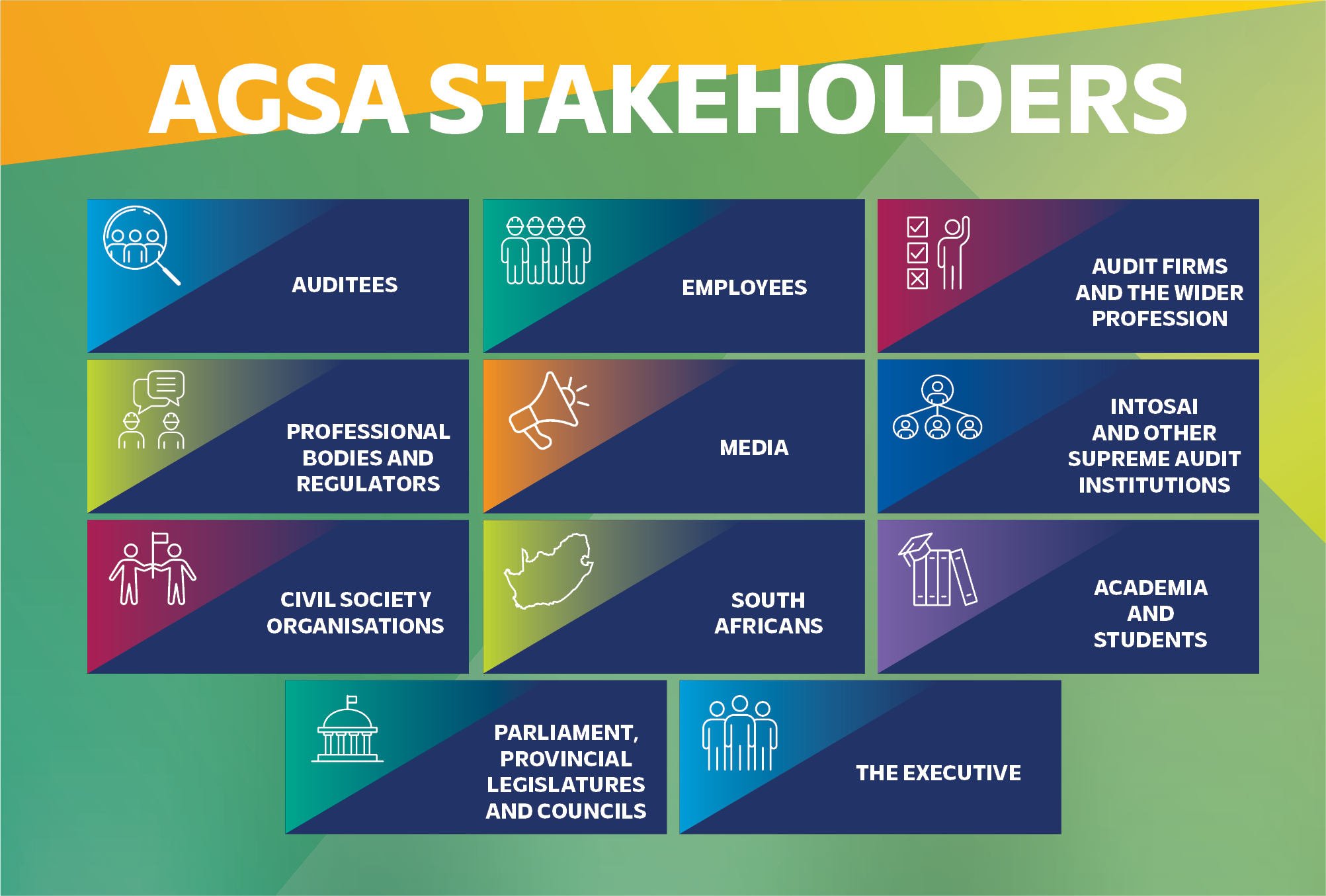
Through its audit work, the institution provides value to its stakeholders that extends beyond the provision of assurance on financial information and the reporting of findings on compliance and performance information. As the country’s supreme audit institution, the value of its work transcends the audits performed and the reports issued. The true value lies in the practical impact of its work, what it enables, what it prevents and what it demands of the public institutions it audits, as well as of the South Africans who rely on them.
The audit as a reflection of performance
At its most fundamental level, the institution’s audit work provides South Africa with an accurate, independently verified account of how public funds are managed. No other institution has the access, statutory authority or breadth of coverage to perform this role. The AGSA audits about 1 000 auditees annually, including national departments, provincial entities, municipalities and public institutions and reports its findings without fear, favour or prejudice. While the resulting picture is not always positive, it is truthful. In a functioning democracy, transparency in the management of public resources is not optional; it is essential. It forms the foundation upon which oversight, accountability and, ultimately, sustainable improvement are built.
The audit as a deterrent
One of the least visible, yet most consequential, functions of an independent audit is its preventative effect. The knowledge that public expenditure will be subject to independent scrutiny and that irregularities will be identified, reported and increasingly pursued through mechanisms such as material irregularities drives behavioural change. It introduces a level of caution and accountability that may not otherwise exist. While this deterrent effect cannot be quantified in monetary terms, it is both real and significant. It represents one of the most important contributions that the AGSA, as an active and credible supreme audit institution, makes to the governance of public resources.
In KwaZulu-Natal, audit procedures at Dr Pixley Ka Isaka Seme Memorial Hospital identified
R48,1 millionin specialised medical equipment at risk of misuse in non-operational clinical units. To prevent this, the department proactively allowed a nearby hospital to use the unoccupied wards and the equipment. It also transferred excess equipment to hospitals in need.
The audit as an enforcement mechanism
Since the 2019 amendments to the PAA conferred upon the institution the authority to identify and act on material irregularities, its work has progressed beyond reporting to driving accountability and consequence management. Accounting officers who fail to address material findings are now subject to escalation, either through referral to relevant public bodies for investigation, recovery or prosecution, or through the issuance of a certificate of debt.
In the 2024-25 financial year of the auditees, the institution facilitated the recovery and prevention of
R4,6 billionin financial losses through the material irregularities process (PFMA: R2,37bn and MFMA: R1,69bn). This represents funds that, in the absence of such intervention, would probably have been permanently lost to the public purse. The process also contributed to strengthened internal controls, corrective action in the submission of annual financial statements, a reduction in disclaimer audit opinions and the restoration of malfunctioning wastewater treatment works that had adversely affected communities.
The audit as a diagnostic tool
Our audit work is one of the diagnostic tools available to South Africa’s public sector. Through it’s audit insights the institution helps auditees across all three spheres of government understand their challenges and the underlying root causes, and provides them with recommendations for how these can be addressed.
Through its general reports, the institution also provides critical insights into the relationship between sound financial management and service delivery outcomes. For example, where municipalities achieve clean audits, there is generally stronger infrastructure management, with budgets, timelines and quality standards more consistently met. This demonstrates that sound financial management is not merely an administrative requirement, but a key determinant of whether services are delivered effectively to communities.
At Mpumalanga Economic Growth Agency, a communication of audit finding was issued on
R2,59 millionin fruitless and wasteful expenditure for materials kept offsite without supporting evidence submitted for audit. The accounting officer immediately ensured that weekly water distribution through tankers was properly recorded and actual performance appeared in the annual performance report for 2024-25.
The audit as a pillar of parliamentary oversight
Our relationship with Parliament extends beyond procedural compliance. The institution actively supports the capacity of portfolio committees and public accounts committees to effectively interrogate executive performance. This includes briefing committees, providing detailed analysis and drawing insights across departments and over multiple financial years. When acted upon, these insights contribute to improved financial management and strengthened governance within auditees.
Additional social value of our audit work and products
Our products and engagements with stakeholders, as outlined in the value-creation model, support the implementation of the #cultureshift2030 strategy and reinforce the institution’s value-add focus. This is achieved by ensuring that audit work is conducted in a manner that not only advances strategic priorities but remains responsive to broader socioeconomic needs. One of the ways in which the institution realises shared value creation is through aligning its work articulated in the multiyear audit plan (Myap) with the United Nations Sustainable Development Goals (SDGs).
Support of the Sustainable Development Goal outcomes
We contribute to the achievement of the SDGs through the independent assurance, insights and enforcement provided in terms of our constitutional mandate. While the institution does not deliver services or implement policy, its audit work plays a key enabling role in strengthening the effectiveness, accountability and sustainability of government programmes that directly affect citizens’ lived realities.
Through Myap, the institution aligns its audit focus areas to priority socioeconomic risks facing South Africa. This approach advances the principle of shared value creation, whereby audit outcomes support improved stewardship of public resources, enhanced service delivery and stronger institutions across all spheres of government.
SDG 16: Peace, justice and strong institutions
Targets 16.3, 16.6, 16.7, 16.a
Strengthening public sector institutions lies at the core of the institution’s mandate. During the 2025-26 period, audit work continued to promote effective, accountable and transparent institutions by highlighting governance weaknesses, delays in consequence management and gaps in coordination across the accountability ecosystem.
Audit insights relating to the integrated justice system, safety and security, coordinating institutions and oversight structures informed Parliament, legislatures and executive authorities on systemic constraints affecting justice outcomes, service delivery and public trust. Through its recommendations and followup processes, the institution contributed to reinforcing the rule of law and strengthening institutional credibility across national, provincial and local spheres of government.
SDG 6: Clean water and sanitation
Targets 6.1 – 6.5
Our audits of water and sanitation infrastructure and services continue to highlight risks to water security, underperformance of infrastructure and weaknesses in operational controls, particularly at the municipal level. Audit insights have focused on water quality management, water losses, wastewater treatment and the sustainability of infrastructure investment. By linking findings to nationally recognised benchmarks, including performance testing regimes and, where necessary, invoking material irregularity enforcement powers, the institution has strengthened accountability for failures that pose direct risks to health, dignity and environmental sustainability. These audits support improved planning, timely remedial action, and enhanced oversight in addressing water scarcity and service delivery challenges.
Our water report, produced in 2025-26, was presented to a number of key stakeholders in the water and sanitation sector, including the Presidency. As one of our key accountability ecosystem partners, we engaged the Presidency on their coordinating role as the leaders of Operation 12 Vulindlela. In terms of value of the report, the Presidency advised that the contents of the report strongly aligned to the water sector-related Operation Vulindlela reform initiatives, and specifically, to the work to be undertaken by the national water crisis committee in its national water action plan.
SDGs 11 and 9: Sustainable cities, communities and infrastructure
Targets 9.1, 11.1, 11.2, 11.3, 11.5, 11.6
Our infrastructure-focused audits assess whether government has established effective systems to plan and deliver safe, resilient infrastructure, including housing, transport, water and sanitation, and public facilities. Particular emphasis is placed on the coordination, execution and oversight of infrastructure programmes, recognising their crucial role in supporting local economic development and social stability.
Audit insights inform oversight bodies of delays, cost overruns, maintenance and governance weaknesses that undermine infrastructure outcomes. By providing objective evidence and enforcing accountability where noncompliance results in, or poses a risk of, harm, the institution supports more sustainable urban development and strengthened infrastructure stewardship.
SDGs 1, 2, 4 and 8: Poverty reduction, education, skills and economic participation
Targets 1.3, 1.4, 2.1, 4.1 – 4.3, 8.3, 8.6
Through audits of basic and higher education, skills development, nutrition programmes, and local economic enablers, the institution provides insights into the effectiveness of government interventions aimed at reducing poverty, improving education outcomes, and supporting employment.
Audit messages focus on integrated planning, targeted interventions, coordination among institutions and the alignment of programmes with national skills needs. By identifying systemic weaknesses and recommending corrective action, the institution supports more equitable access to education and skills development, particularly for vulnerable groups, thereby indirectly contributing to inclusive economic growth.
SDGs 12, 13 and 15: Environmental sustainability and climate action
Targets 12.4, 13.1 – 13.2, 13.b, 15.3
Our audits of environmental management and climate-related programmes emphasises the impact of environmental degradation and climate risk on communities, particularly at the local government level. A key focus is on compliance with environmental legislation, rehabilitation and the adequacy of governance frameworks addressing climate-related risks.
Where weaknesses are identified, the institution shares audit insights with oversight structures to promote timely remedial action and strengthened consequence management. In instances of noncompliance that resulted in, or poses a substantial risk of, harm, the institution exercises its enforcement powers to reinforce accountability. This work supports resilience, environmental protection and sustainable land-use outcomes.
SDG 7: Affordable and clean energy
Targets 7.1, 7.3, 7.b
Our audit work in the energy sector focuses on the adequacy of planning, data integrity, oversight and enforcement across selected state-owned entities and local government functions. Insights on energy infrastructure, maintenance, planning and regulatory compliance informed the national discourse on energy sustainability, affordability and security.
SDG 17: Partnerships for the goals
Target 17.1
We support domestic resource mobilisation and fiscal sustainability by providing independent assurance over public finances and state-owned entities. Audit insights on fiscal pressures, turnaround strategies, revenue and financial management enable informed oversight and decisionmaking, thereby strengthening the broader accountability ecosystem required to finance sustainable development outcomes.
Conclusion
South Africa has progressed in a number of its SDG focus areas, notably basic infrastructure, social protection and human development. As part of its basic infrastructure commitments, the country has expanded basic access to electricity, safe drinking water, sanitation and digital connectivity. On social protection, large-scale social assistance programmes continue to support millions of citizens. Within human development, the country has recorded progress in school enrolment, healthcare access, and gender parity.
The institution will continue to refine the alignment between its audit focus areas and national development risks, ensuring that its audit work remains responsive to socioeconomic priorities. Through consistent assurance, insights, influence and enforcement, our contribution to the SDGs will remain indirect yet significantly reinforcing accountability, strengthening institutions and supporting longterm sustainable development.