
Who we are
Mandate and legal form
The AGSA is the country’s supreme audit institution. Its mandate is derived from chapter 9 of the Constitution of the Republic of South Africa, 1996. The institution is an organ of state, as defined in section 239(b)(i) of the Constitution, with full legal capacity and operating as a juristic person. As one of the six institutions established by chapter 9 to support constitutional democracy, its independence is constitutionally entrenched and it is subject only to the Constitution and the law. The Constitution further requires the institution to act impartially and to exercise its powers and perform its functions without fear, favour or prejudice. These functions are prescribed in section 188 of the Constitution as well as chapters 2 and 3 of the Public Audit Act 25 of 2004 (PAA).
Accountability and reporting
The AGSA accounts to the National Assembly through the tabling of its annual report, financial statements and the associated audit report. This requirement is governed by subsection 10(2)(b) of the PAA.
Financial and legal independence
The institution’s legal and financial independence is underpinned by its legislative framework and funding model. This legislative independence enables the institution to make decisions free from executive influence. Although consultation takes place with the National Assembly’s Standing Committee on the Auditor-General (Scoag) the National Treasury on budgetary matters, the auditor-general ultimately approves the institutional budget and exercises independent discretion in determining the basis for the calculation of audit fees.
Sources of revenue
Section 36 of the PAA authorises the AGSA to access funding through multiple sources. Although the primary source of revenue is audit fees charged for the audits performed, the institution may access funding via parliamentary appropriations, interest earned on investments or from sources otherwise becoming available to the institution. Application for appropriation is made only in exceptional cases, such as instances where additional funding is required for invoking its amended statutory powers. Below is an indication of our exact revenue sources:
- Audit fees – The primary source of revenue is audit fees, which are discussed with auditees’ executive management and approved by the respective audit committees, based on the scope and effort of the audit.
- Audit fees collected directly from the National Revenue Fund for auditees that are financially distressed and are unable to pay (in line with section 23 of the PAA).
- Parliamentary appropriations (allocated funding) — applied in exceptional circumstances, such as instances where the AGSA invokes its amended powers.
Funding model principles
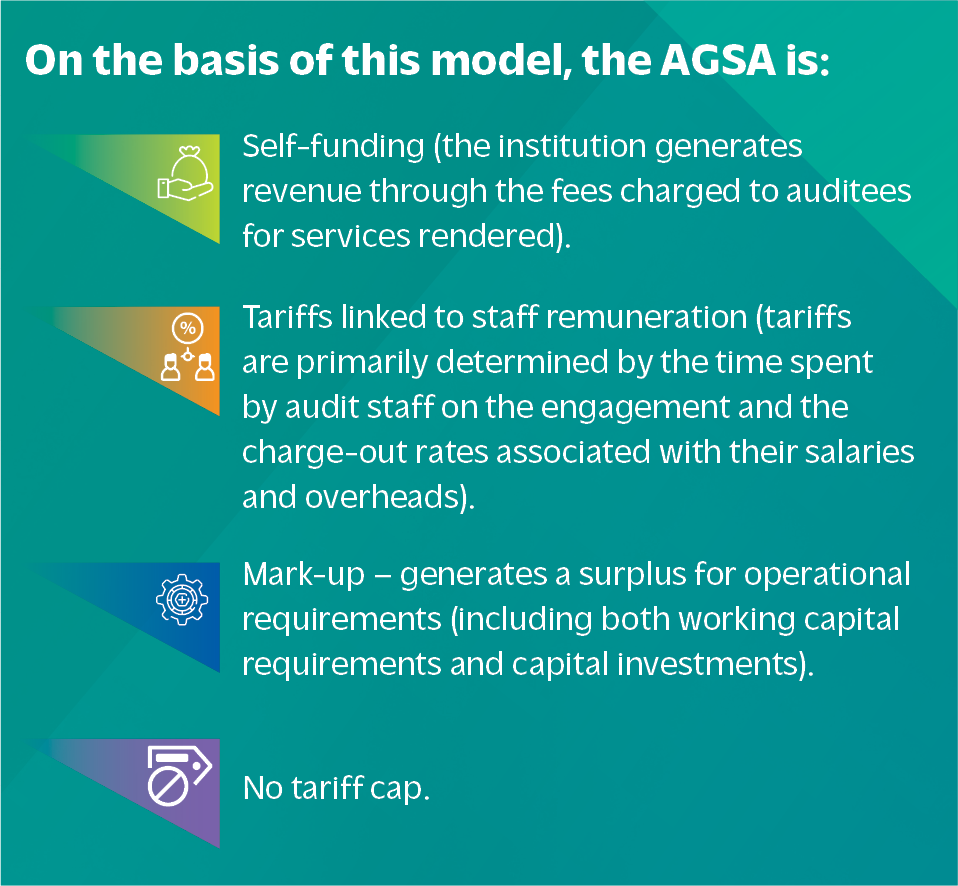
The funding model of the AGSA is premised on the institution being self-sustaining and financially independent. This type of funding model also secures the legal independence of the institution.
Functions, beneficiaries and products
In terms of its legislative mandate, the institution audits and reports on the utilisation of public funds by government. This responsibility includes the undertaking of financial audits as well as discretionary audits, including performance audits, special audits and investigations.
The institution conducts mandatory annual financial audits, through which it audits and reports on financial statements, performance reporting, compliance with key legislation and material irregularities across national and provincial government departments, public entities, municipalities, municipal entities and state-owned entities (referred to as auditees).
Audit reports are issued to reflect the outcomes of these audits, with particular emphasis on identified material irregularities. Auditees are required to include these audit reports in their annual reports, which are subsequently tabled before the relevant oversight structures, including the National Assembly, provincial legislatures and municipal councils.
In addition to audit reports, the institution publishes general reports that provide analysis of audit outcomes across national, provincial and municipal spheres, as well as special reports that present findings from real-time or other standalone discretionary audits.
These reports support councils, legislatures and Parliament in exercising effective oversight and in holding the executive accountable for the management of public funds.
International participation
The AGSA is an active member of Intosai. The institution leads Intosai’s capacity building committee, serving as its advocate and custodian for the development of the capacity of supreme audit institutions across diverse global jurisdictions. In addition, the AGSA participates in several Intosai working groups, which facilitate the exchange of ideas, knowledge and experience among members and support the collaborative development of solutions to common challenges.
The AGSA contributes to the development of supreme audit institutions in Africa through strategic cooperation within Afrosai, including participation in its governing board and its two capacity development committees. The institution also continues to host the secretariat of of Afrosai-e, a regional chapter of Intosai. Through the provision of funding, resources and access to technical expertise, the institution supports targeted capacity development initiatives for its 26 member institutions.
The successful collaboration with Afrosai-e led to it being awarded the October 2025 Kimi Makwetu Award by Intosai. This global award was in recognition of Afrosai-e’s exceptional contributions to capacity building in public sector auditing.
The AGSA has further strengthened its international engagement through an expanding portfolio of international audit assignments. These include audits of the United Nations Educational, Scientific and Cultural Organisation (Unesco), the International Centre for Genetic Engineering and Biotechnology, the African Organisation of Public Accounts Committees and the African Union.