
Influencing for impact
Performance against 2025-26 targets
| Key performance indicator | 2025-26 target | Year-end actual | Status |
|---|---|---|---|
| The auditor-general’s assessment of the audit portfolio’s work to make accountability ecosystem members for targeted auditee segments more active and effective | Favourable assessment | Favourable assessment | |
| AGSA public sentiment rating | 90% – 100% implementation of improvement plans for 2025-26 | 94% | |
| Percentage of achievement of outcomes targeted in stakeholder programme | 75% – 80% | 86% All the agreed-on key stakeholders were engaged and the key engagement outcomes attained (for instance, closer collaboration with the Institute of Internal Auditors SA) | |
| Implementation of the cultureshift coalition programme | 80% – 100% implementation of approved 2025-26 actions | The pilot programme has been implemented, with rollout planned for 2026-27 | |
| Execution of supreme audit institution (SAI)20 hosting and 2026 SAI performance management framework assessment planning | Successful hosting of SAI20, per the auditor-general-approved event project plan | Successful hosting of SAI20, per the auditorgeneral- approved event project plan | |
| 90% – 100% implementation of preparation actions outlined in the DAG and AG-approved 2026 SAI PFM Assessment plan | 100% implementation against the assessment plan |
Influence in action
In the year under review, stakeholder engagement was strengthened through structured programmes with clear objectives, milestones and tracking mechanisms. The focus was on high-impact auditees and priority themes. These included metros, disclaimed and yellow zone auditees, key public entities and crucial value chains.
Measurable gains include increased stakeholder demand for AGSA audit insights, more proactive engagement from auditees, greater understanding of the causes of poor audit outcomes and stronger alignment between influence and enforcement interventions.
Nevertheless, auditee sustainability is subject to ongoing leadership instability and weak consequence management, which continue to undermine the durability and longterm impact of reforms. Addressing these systemic constraints is essential to sustain compliance and enhance service delivery.
Examples of our influence successes
- Through the AGSA’s influence, an R898 million driving licence printing tender at the Road Traffic Management Corporation was set aside, following procurement irregularities identified through multidisciplinary audit work.
- Corrective actions at entities including South African Airways and Denel stabilised governance and ensured more timely submission of annual financial statements, enabling the finalisation of long-outstanding audits during 2024-25.
These outcomes show that the AGSA influence is most effective where boards and executive authorities engage actively with the institution, own the corrective actions and translate audit insights into decisive governance and management interventions.
Metropolitan municipalities
In the year under review, the institution’s audit teams utilised a continuous, strategic and diagnostic engagement model to enable earlier identification of risks, deeper cause analysis and more assertive enforcement messaging. Using this model, the institution engaged in regular, structured engagements with mayors, speakers, municipal public accounts committees, audit committees and city managers, strengthening accountability across political and administrative leadership. Status of records reviews and interim audit insights escalated risks ahead of year end. Recurring governance and consequence management failures were repositioned to sustain engagement and pressure.
In addition, a chief information officer forum on 12 August 2025 brought together officers from all eight metropolitan municipalities to strengthen ICT governance and address persistent audit challenges. Complementary engagements with the Government Information Technology Officer Council and Information Systems Audit and Control Association platforms created awareness of key ICT risks and aligned the AGSA with the national digital roadmap, reinforcing its role in shaping ICT governance.
Despite these strategic investments, implementation remains inconsistent, particularly in supply chain management, infrastructure delivery, ICT governance and performance reporting. These constrain the depth and sustainability of impact, indicating the need for more differentiated interventions to drive lasting behavioural change.
Disclaimed auditees
Disclaimed auditees were supported through intensified interventions that shifted the focus from generic corrective actions to cause-driven solutions. These interventions were reinforced through early engagement, clear consequence management messaging and coordinated support from institutions such as the Department of Cooperative Governance and Traditional Affairs and National Treasury. Initiatives including North West’s ‘eradication of disclaimers’ can shift outcomes, reducing the number of disclaimer opinions, with several auditees improving to qualified or unqualified audits.
Structured follow up on priority projects and governance failures translated audit findings into tangible corrective actions. These included remedial construction, recovery, greater audit committee oversight, improved financial reporting and greater senior management stability. By applying leadership structure alignment and accountability mechanisms these interventions sustained progress.
Yellow-zone auditees
Yellow zone auditees are at risk of complacency, with apparent audit stability often misinterpreted as progress. This can obscure underlying stagnation or regression in compliance, financial discipline and service delivery performance.
Through escalated and targeted messaging to members of the executives, heads of department, Cabinet, legislatures and oversight committees, the AGSA shifted engagements from defensive compliance to institutional ownership of risks. Emphasis was on addressing structural weaknesses through focused, auditee driven audit action plans, with clearer accountability for internal audit functions and audit committees. While this approach has improved leadership awareness and visibility of risk, progress remains uneven. In several portfolios, increased awareness has not consistently led to correction, as shown by repeat noncompliance and sluggish improvement in supply chain management and performance reporting.
Key public entities and SOEs
Strong governance arrangements and effective internal control environments have enabled entities such as the Development Bank of Southern Africa and the South African Revenue Service consistently to sustain clean audit outcomes. This demonstrates that accountability and transparent reporting are achievable even in complex and high risk environments.
The former progressed from doing the basics to doing more than the basics by aligning data driven, tactical actions with its core operations and prioritising sustainable revenue generation. Underpinning this was structured engagement across management, internal audit and audit committee, reinforcing disciplined execution and continuous improvement.
Other key public entities – including South African Airways, Transnet, the Property Management Trading Entity and Denel – face persistent challenges of going concern sustainability, infrastructure delivery and operational resilience, highlighting uneven governance maturity.
During the year, the Road Accident Fund resolved and deescalated longstanding accounting and litigation disputes. Minister of transport and Scopa collaboration culminated in the dissolution of the fund’s board and substantive changes to senior management, creating conditions for corrective action and institutional reform.
Coordinating institutions
Coordinating institutions are increasingly engaged and aligned, although effectiveness remains uneven across provinces and sectors. Through contact during both the MFMA and PFMA cycles and by elevating audit messages to platforms such as Troika (comprising executive mayor, council speaker and chief whip), MinMECs (comprising Cabinet ministers and members of the executive council) and executive committees, the AGSA ensured continuity of oversight momentum post elections and positioned audit insights actively to shape executive priorities and sector interventions.
This enabled earlier risk identification, stronger coordinated oversight and more targeted corrective action – extending the impact of audit work beyond individual auditees and contributing to measurable improvements in accountability and governance. During the MFMA cycle, recurring supply chain management and infrastructure delivery weaknesses in municipalities were escalated from individual councils to platforms involving the Department of Cooperative Governance and Traditional Affairs, provincial treasuries and premiers’ offices.
In this way, audit findings were repositioned as sector wide governance and capability risks, prompting coordinated responses such as intensified monitoring of high risk municipalities, support initiatives and strengthened provincial oversight. Action to counter regressions was taken earlier and accountability expectations were clarified for accounting officers and municipal councils.
During the PFMA audit cycle, the AGSA referred control weakness, repeat noncompliance and governance failure insights to senior executive forums, including MinMECs, troika and portfolio committees. This ensured that audit risks informed executive priority setting rather than remaining confined to audit close outs. Executive ownership of audit outcomes was strengthened, credibility of corrective action commitments improved and fragmented, project by project remediation became more systemic, coordinating institution led responses, particularly in infrastructure delivery.
While these efforts bolstered oversight through regular follow up, resolution tracking and Cabinet attention, inconsistent consequence management continues to hinder impact, which demands decisive accountability and firmer enforcement.
Assurance providers and oversight
Influencing oversight structures, particularly internal audit and audit committees, has emerged a game changer for sustainable improvement, strengthening follow through on audit recommendations and management commitments. The impact is most pronounced where internal audit functions are centralised at treasuries, enabling greater consistency, enhanced capability and more effective oversight across institutions.
These functions are key change agents in yellow zone auditees, where persistent noncompliance, especially in supply chain management and the quality of financial and performance reporting, continues to pose a risk. Through deeper engagement informed by assessments of their authority and capability, the AGSA strengthened these structures’ oversight effectiveness. This reinforced combined assurance arrangements, clarified accountability and supported more consistent implementation of corrective actions.
Oversight level advocacy, grounded in AGSA audit evidence, translated increasingly into tangible corrective action, particularly through Scopa oversight visits and MFMA hearings. These triggered remedial measures, including interventions on stalled infrastructure projects. In provinces such as Eastern Cape, escalation of material irregularities through Scopa preceded national funding support, illustrating the role of evidence based oversight in unlocking responses.
These interventions improved the quality of audit action plans, strengthened recommendation tracking and broadened ownership beyond management. However, oversight effectiveness remains uneven, with some structures still lacking depth and sustained focus on consequence management, constraining full and lasting impact of interventions. In certain instances, sound recommendations from internal assurance structures are not implemented by administration, further limiting progress.
Media and civil society organisations
During 2025-26, the institution converted its reports into activation tools, leveraging media liaison to shape public discourse on accountability and governance. This influence strategy included structured media training and capacitation, notably with the South African National Editors’ Forum, to strengthen awareness of the AGSA mandate and role.
As a result, journalists better understood the AGSA’s enhanced powers and complex audit instruments (including issuance of the first certificates of debt), leading to more accurate, contextualised reporting. Media coverage extended to special reports on education and the water sector, which generated significant public interest. This reduced misreporting and generated more substantive coverage, moving beyond headline narratives to clearly explained consequences, implications and oversight outcomes. Hosting the SAI20 generated media coverage valued at about R5 million, further positioning the audit office’s international status.
Executives, including senior managers, were capacitated through media training and deployed across platforms in multiple languages, increasing the AGSA’s share of voice. Independent media analysis indicates that the AGSA secured substantial earned mainstream and community media coverage worth some R2,6 billion (compared to R886 million in the previous year) and credibility through its audit insights. During the year, the AGSA was referenced more than 20 000 times across media platforms.
Passive reporting has evolved into active amplification of transparency, accountability and oversight. Sustained engagement with media stakeholders has enabled more proactive interaction, resulting in increased reference to AGSA reports in coverage on government accountability and reinforcing the institution’s role in public sector governance. Key themes reflected in media coverage included the AGSA’s enhanced powers, material irregularities and certificates of debt, general report findings, particularly municipal, persistent challenges in accountability and service delivery (including water, infrastructure and mining), audit outcomes within Budgetary Review and Recommendations Report processes, the role of the accountability ecosystem and the SAI20.
Relationships with civil society organisations continued displaying results through shared information and influence, particularly in professionalisation and grant management risks. These engagements complemented formal oversight mechanisms and further drove systemic impact.
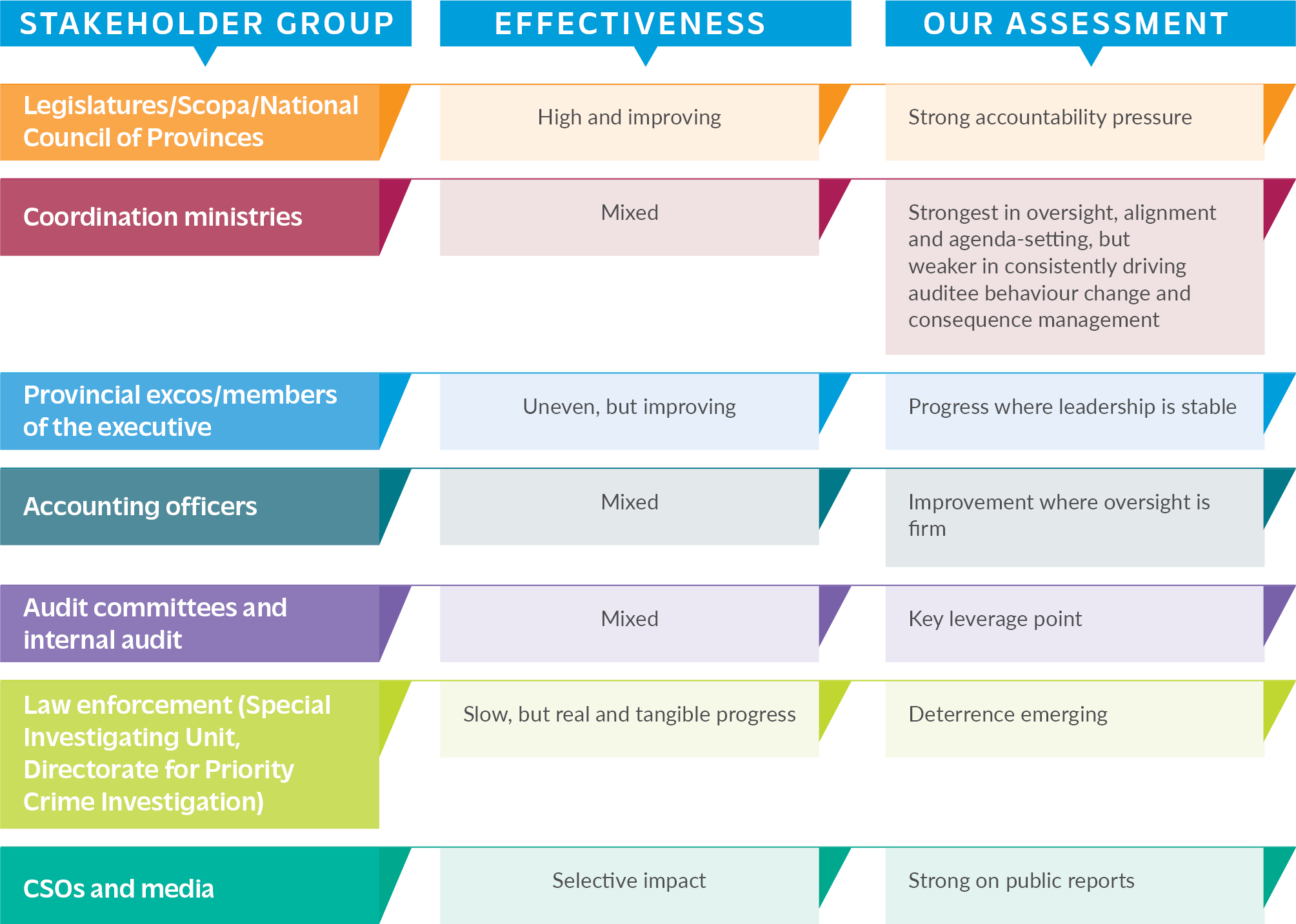
Stakeholder effectiveness assessment
Conclusion
In 2025-26, the AGSA’s influence work became more deliberate, structured and strategic, delivering stronger impact where engagement was reinforced by effective enforcement and supported by coordinating institutions. The institution will sharpen its focus on high-risk stakeholders, intervene earlier, bolster governance capability, coordinate systemwide responses and deepen the integration between influence and enforcement to sustain impact and enhance accountability.